
Ok . . . so it occurs to me, as I muse over Acts 7, that Stephen could have saved himself a lot of trouble, not to mention his very life, if he had just said “No.” As he stood before the council, the high priest asked him, “Are these things so?” (Acts 7:1) Technically, that’s a closed question . . . only two possible answers . . . yes or no . . . and I’m thinking he could have said, “No.” The accusation was that he spoke blasphemous words against Moses and God (6:11) . . . that he spoke against the holy temple and against the law (6:13) . . . that he was preaching that Jesus would destroy their place of worship and was going to re-write the customs given by Moses (6:14). And so, as he stood before this kangaroo court, when asked the short question, “Is this true?”, couldn’t he just have given a short answer like, “No?” I guess not.
I guess that men who are full of the Spirit and wisdom (6:3), who are full of faith and empowered of God to defend that faith (6:8, 10), are the kind of men who take advantage of the open door even if it costs them dearly. And as I read his defense in Acts 7, he responds to the closed question by addressing the accusation. He talks about Moses and God and the temple and the law and Jesus . . . and, he talks to me.
Stephen takes these religious leaders through their beginnings . . . from Abraham, Isaac, Jacob . . . from Joseph being sold into slavery in Egypt to the family of Israel relocating there. And then, he talks of Moses the deliverer. Moses, the one raised up of God but not recognized by his fellow Israelites (7:25). Moses, the one who stood barefoot before God on holy ground and was commissioned by God to deliver the people from bondage (7:33-34). This Moses, whom the people rejected was the one God sent to be ruler and deliverer (7:35) . . . and was the one who prophesied, “The Lord your God will raise up for you a Prophet like me from your brethren. Him shall you hear.” (7:37, Deut. 18:15). Moses wasn’t blasphemed by Stephen . . . he was believed!
Concerning the law . . . Stephen reminded them that Moses had brought “the living oracles” of God down from the mountain but their fathers “would not obey, but rejected. And in their hearts they turned back to Egypt” (7:38,39). They would be delivered by God, but they’d serve God on their terms. They’d be brought out of the bondage of Egypt, but they wanted to keep Egypt’s values and worship. Who was anti-law?
Anti-Moses? Anti-law? No way! That’s not what Stephen preached . . .that’s not what Christ preached. In fact, Jesus said, “Do not think that I have come to abolish the Law or the Prophets; I have not come to abolish them but to fulfill them” (Matt. 5:17). But just as their ancestors had rejected Moses as deliverer, this hard-hearted brood of vipers refused to recognize Jesus as the Christ, the one spoken of by Moses. They would take the law of God and hamstring it with their self-serving, righteous-through-works, religious customs of men.
Ok . . . so maybe it’s becoming clearer why Stephen couldn’t have just said, “No.”
And then Stephen talked of the tabernacle . . . the temple . . . the place of God’s dwelling. “The Most High does not dwell in temples made with hands, as the prophet says: ‘Heaven is My throne, and earth is My footstool. What house will you build for Me? says the Lord, Or what is the place of My rest? Has My hand not made all these things?’ ” (7:48-49). It had never been about the place . . . it had always been about the Presence. God’s place is in heaven . . . but His desire is that His presence would be among men. They had become focused on the building over the Builder. Yup . . . led by the Spirit, given the opportunity to reveal their self-seeking, hard hearts and their resistance of the things of God, just saying “No” wasn’t really an option for Stephen.
And I guess, it serves as a bit of a self-check for me. To beware of turning my heart back to Egypt . . . of wanting “the best” of the world and then fitting God in around that. And it’s reminder to beware of conforming the Bible to my agenda. And it’s not about “going to church” but about “being the church” . . . not about a place on Sunday morning but about a presence 24/7. It’s a warning about not becoming hard-hearted . . . and stiff-necked . . . and resisting the Holy Spirit. It’s a warning that Stephen gave his life for. Oh, what instruction would have been lost had Stephen simply answered, “No.” Praise God, that he was led to give a long answer to a short question.
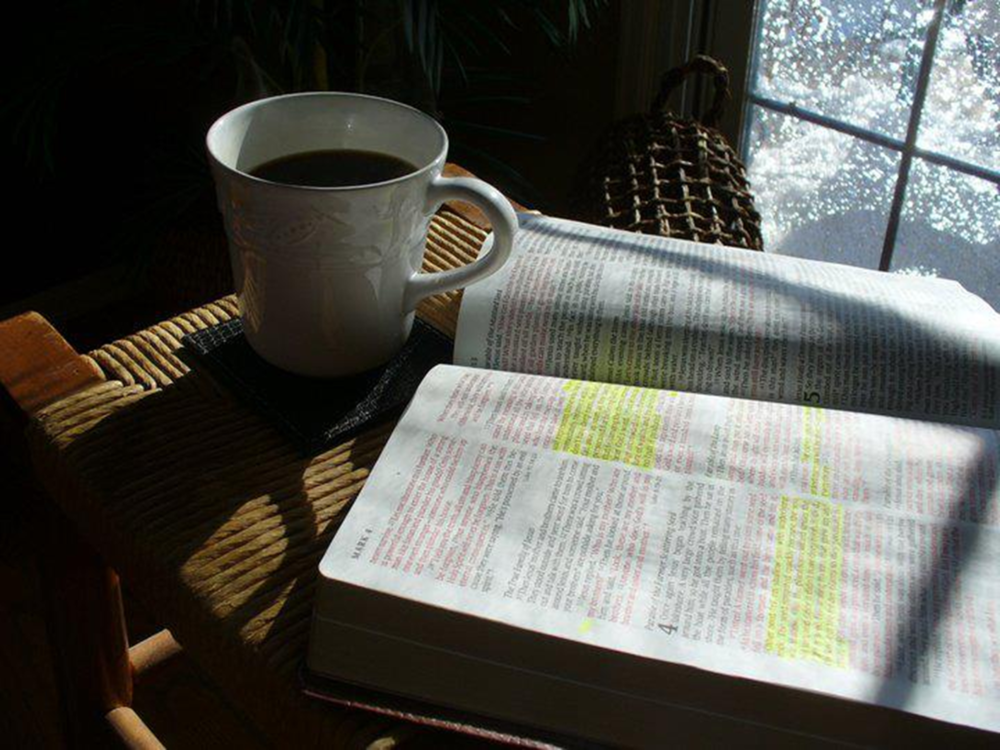
 My Morning Meal