
As they approached the tent, I’m guessing their senses were alive. Certainly the priest could see the Holy Place before him . . . that, in and of itself, might have set the adrenaline in motion in anticipation of drawing nearer to the Holy of Holies. In the background they may noticed the sound of the wood crackling and the burnt offerings sizzling. They would feel the water still on their hands after the preparatory washing be entering into sacred duty. And as they approached the tent of meeting, what did they smell?
The LORD said to Moses, “Take the finest spices: of liquid myrrh 500 shekels, and of sweet-smelling cinnamon half as much, that is, 250, and 250 of aromatic cane, and 500 of cassia, according to the shekel of the sanctuary, and a hin of olive oil. And you shall make of these a sacred anointing oil blended as by the perfumer; it shall be a holy anointing oil. With it you shall anoint the tent of meeting and the ark of the testimony . . . ” (Exodus 30:22-26 ESV)
As I’m wrapping up this portion of Exodus which deals with the instructions given to Moses for the building of the tabernacle I’m struck by the fact that, along with everything that was to be made, . . . that, in addition to all that was tangible about the tabernacle, . . . that there would also be this invisible aroma about the place where the glory of God would dwell.
Apparently a shekel was about .4 ounces. That means that about 12 pounds of liquid myrhh, which I understand carried a very strong scent, was mixed with 6.5 pounds of “sweet-smelling cinnamon” and another 6.5 pounds of “aromatic cane” . . . and it was to be mixed together with olive oil “by the perfumer” as a holy anointing oil. That’s 25 pounds of permeating odor to spread over an area about 10 strides long and 5 strides wide . . . to sprinkle on the tent and everything in it including the ark. Seems to me that’s a pretty small area to release that amount of perfume. I’m thinking the odor would be noticeable.
And I’m trying to imagine the smell . . . and the impact of this invisible reminder that this place is holy. And what it foreshadows of God’s current day temple . . . the church (Eph. 2:21-22).
The anointing we experience today is that of the Holy Spirit. The invisible means by which we have been consecrated and set apart is through the abiding presence of the Third Person of the Trinity. And so I’m thinking . . . shouldn’t we smell a bit?
Not literally, of course. But shouldn’t there be an intangible something in the air when people experience the church of God. The church as in the people . . . not the building . . . not the programming . . . but those living stones who are being built into a holy temple in the Lord, a dwelling place for God. Not some airs that we put on . . . but a distinctive “aroma” that is put on us because a Most Holy God has redeemed for Himself a holy people through the blood of His holy Son. And in that redemption, there is a setting apart . . . a consecration . . . an anointing of the Holy Spirit. And with that, if the tent of meeting in Exodus is an indicator, there should be a certain something in the air that says these are God’s people . . . and here, is God’s presence.
But thanks be to God, who in Christ always leads us in triumphal procession, and through us spreads the fragrance of the knowledge of Him everywhere. For we are the aroma of Christ to God among those who are being saved and among those who are perishing, to one a fragrance from death to death, to the other a fragrance from life to life. Who is sufficient for these things? (2Corinthians 2:14-16 ESV)
Who is sufficient for these things? Not me. Rather, the anointing Spirit is poured out on sinners-saved-by-grace that, through the fragrance upon them, the God of glory might be known.
Oh, that by the grace of God, we might smell a bit. Amen?
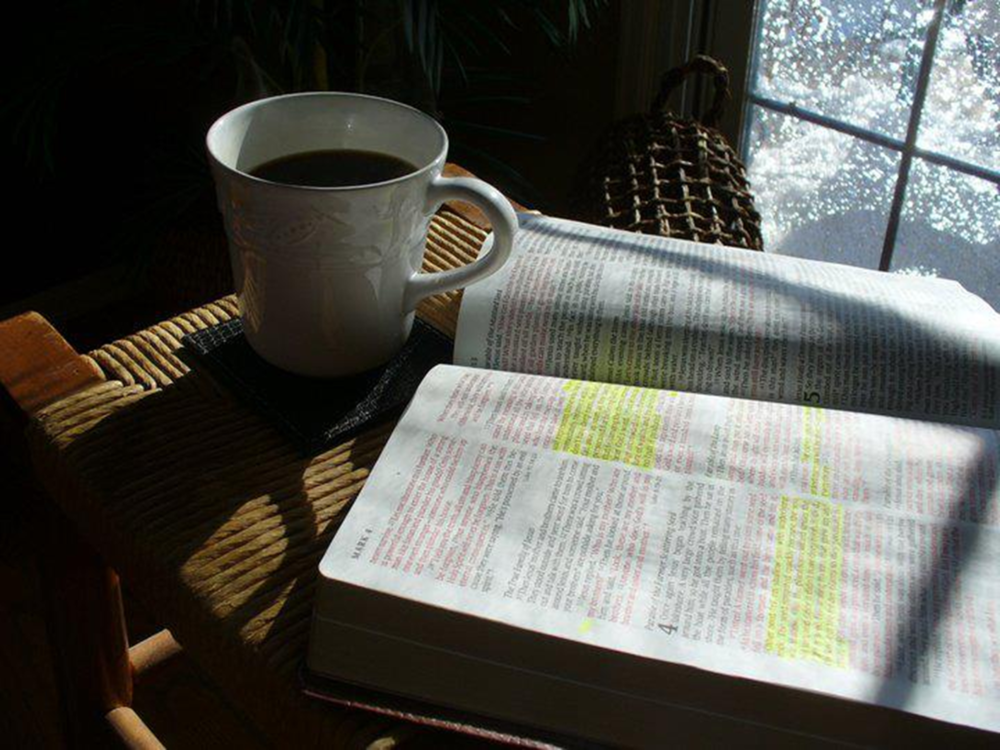
 My Morning Meal