
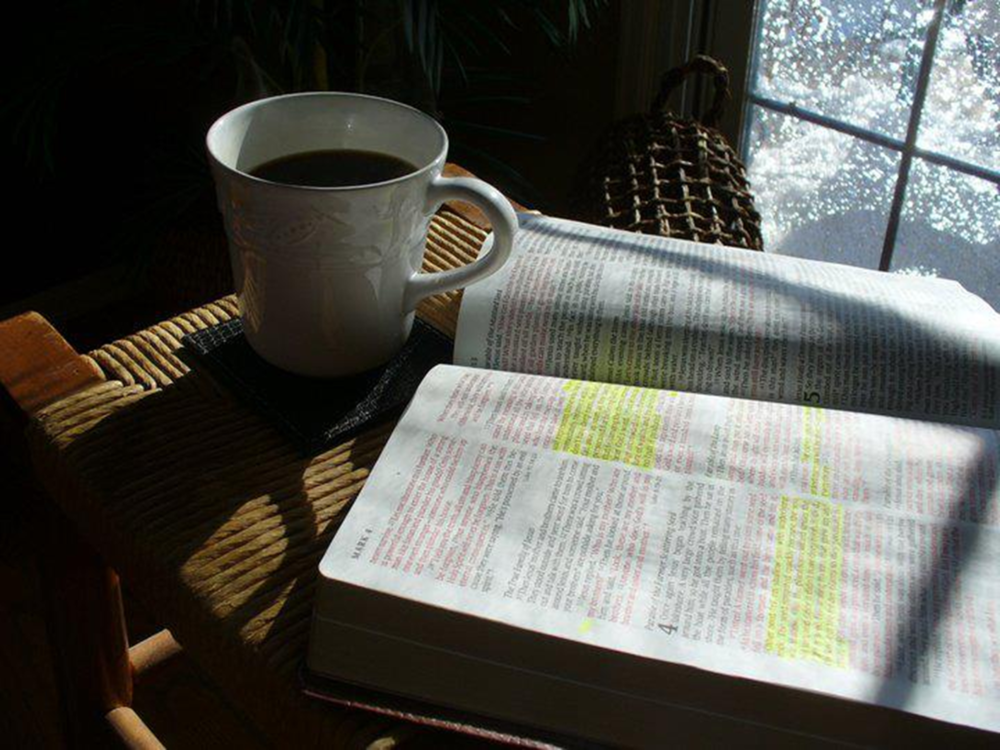
Among the different topics I keep an eye open for as I’m reading, verses or passages about “worship” or “praise” are underlined with a brown colored pencil. Now, you might expect to use the brown colored pencil a fair amount in the Psalms, and might not expect to use it too much in 1Chronicles . . . but, you’d only be half right. In 1Chronicles you find praise and worship and music as the ark is brought up to Jerusalem . . . and it culminates in a wonderful psalm where a number of verses get underlined in brown. And then you get to where I am this morning and hit 1Chronicles 25 and the whole chapter is devoted to “The Musicians.”
In chapter 23, as David draws near to the end of his life he does a couple of things:
1) he makes his son Solomon king over Israel; 2) he sets in order the priests and Levites for ministry in the house of the Lord . . .
The Levites, thirty years old and upward, were numbered, and the total was 38,000 men. “Twenty-four thousand of these,” David said, “shall have charge of the work in the house of the LORD, 6,000 shall be officers and judges, 4,000 gatekeepers, and 4,000 shall offer praises to the LORD with the instruments that I have made for praise.” (1Chronicles 23:3-5).
Get that? . . . of the 38,000 Levites eligible for serving the Lord in the temple, 4,000 were musicians . . . more than one in ten . . . and their service was to be making music . . . and their audience was to be the Lord . . . talk about your music team! So do you think music and song were an important part of worship and temple activity? I’m thinking so.
Then I get to 1Chronicles 25. And it seems that within that broader company of musicians there was a select group. This select group . . . 288 musicians (25:7) . . . 24 “worship teams” of 12 “band members” per team (25:9-31) . . . who were all about “music in the house of the Lord” (25:6). They were trained by their fathers for “the service of the house of the God” and were under the authority of the king himself. So this was important stuff . . . an integral part of the temple activity.
And here’s what grabbed me again this morning. It wasn’t just about making music . . . it wasn’t about providing a bit of entertainment or warming up the crowd . . . it wasn’t just about some preliminary activity to set the mood before the offerings. Rather, this select group was “set apart for the service” as those “who prophesied with lyres, with harps, and with cymbals” (25:1). They prophesied . . . they were to write and sing songs that declared the truths of God. And it’s not like the thought is some “one hit wonder” . . . but it’s repeated again . . . there’s a group of musical brothers mentioned, the sons of Jeduthun, who, under their father’s direction . . .
. . . prophesied with the lyre in thanksgiving and praise to the LORD.
. (1Chronicles 25:3 ESV)
The music wasn’t intended to just stir the soul with melody but to offer thanksgiving to the LORD. The songs were meant to be more than just some background music . . . more than just clever instrumentation . . . they were to bring praise before Him who is worthy of all praise. There was to be a message in the music.
Want to know what’s behind the temple? Want to understand why the sacrifices? Want to appreciate Who it’s all about? Listen to the music!
As these skillful musicians played their stringed instruments and their harps and their cymbals, the words of the song would convey the works and wonders of the God of this place. The lyrics would tell of His great being . . . revealing something of the character of God . . . His sovereignty . . . His holiness . . . His loving kindness and mercy. The songs would tell of His works . . . His choosing of Abraham, Isaac, and Jacob . . . His deliverance from Egypt . . . His protective hand in the wilderness . . . His delivery of the promised land to His promised people. Whether there was three chords used in the song . . . or whether it was arranged for a symphony . . . its purpose was to proclaim a message . . . the message of an awesome God . . . worthy of sacrifice . . . worthy of praise . . . worthy of worship.
Not going to lie to you . . . I’m a bit partial to the “worship” part of our Sunday morning services. What a great opportunity for the congregation to “preach” before the pastor does. Let’s not lose focus on the message in the music . . . may the instruments not drown out the intent . . . may the singers fade into the background as the One being sung to and sung about takes “center stage.”
Listen to the music . . . sing the song . . . for the glory of God . . . amen!
 My Morning Meal