
Connecting some dots this morning between two of my readings.
In Nehemiah, it’s the written, officially sealed, binding agreement of a people taking an oath of obedience. In Luke, it’s the story of a wince-invoking, offensively sanctimonious, boastful assertion of a person who thinks they’ve aced their oath of obedience.
And it’s giving me something to chew on. How did it get from point A to point B, and what can be done to avoid it? What’s at the heart of the corruption of a commendable covenant?
The context for my Nehemiah 10 reading is the fasting and prayer of Nehemiah 9. There, the people are led to reconsider God’s creation of all things, His selection of Abram, His redemption of Israel, and His protection in the wilderness (Neh. 9:1-15). Only to be met by their ancestors’ rejection of His commands and statutes. Eventually to result in their ejection from the land (Neh. 9:16-37). But now, they are back. Now, they determine to live out a different legacy and they formalize that determination in writing (Neh. 9:38). Cue Nehemiah 10.
Those whose seals were on the document [and] . . . The rest of the people — the priests, Levites, gatekeepers, singers, and temple servants, along with their wives, sons, and daughters, everyone who is able to understand and who has separated themselves from the surrounding peoples to obey the law of God — join with their noble brothers and commit themselves with a sworn oath to follow the law of God given through God’s servant Moses and to obey carefully all the commands, ordinances, and statutes of the LORD our Lord.
(Nehemiah 10:28-29 CSB)
Commit and obey . . . for there’s no other way. Sounds good. And yet, there’s a foreboding sense in this. For those who have “read ahead”, a nagging something about the taking of oaths that sounds an ominous warning (Matt. 5:34, James 5:12, Prov. 20:25). Now cue Luke 18.
[Jesus] also told this parable to some who trusted in themselves that they were righteous and looked down on everyone else: “Two men went up to the temple to pray, one a Pharisee and the other a tax collector. The Pharisee was standing and praying like this about himself: ‘God, I thank you that I’m not like other people — greedy, unrighteous, adulterers, or even like this tax collector. I fast twice a week; I give a tenth of everything I get.’
“But the tax collector, standing far off, would not even raise his eyes to heaven but kept striking his chest and saying, ‘God, have mercy on me, a sinner!’ I tell you, this one went down to his house justified rather than the other . . .
(Luke 18:9-14a CSB)
Sounds like the Pharisee was obedient. Sounds like he took seriously his great, great, great, grandfathers’ oath to commit fully and obey carefully. And yet, he’s put forward here by Jesus as a bad example of committing fully. He is weighed in the balance and shown to be coming up short in obeying carefully. How come?
One possible answer? Nehemiah’s written oath after rebuilding the walls around the temple, though containing a lot of “we will’s” and “we will not’s”, failed to account for any of Solomon’s “when we’s” prayed at the dedication of the temple (1Kings 8:22-53). Note to self: self-determination — even when it’s a holy determination — can only take you so far. At some point “we will obey all things”, if we’re honest with ourselves, ends up with “we have sinned in way too many things.” And if there’s no place to deal with the “when we’s” then a commendable covenant can become a corrupted covenant. A sincere oath becomes an arrogant, self-delusional prayer.
Thank God that we are like other people. Sinners saved by grace always in need of mercy.
Thank God for the cross! Praise the Father for sending the Son to deal with all our “when we’s” even as we try to walk in our desire to be true to our determined “we will’s”.
How we need to find our place in the shadow of Calvary on a regular basis. How we need the blood of Jesus for when we fail — even as we seek to obey.
By His grace. For His glory.
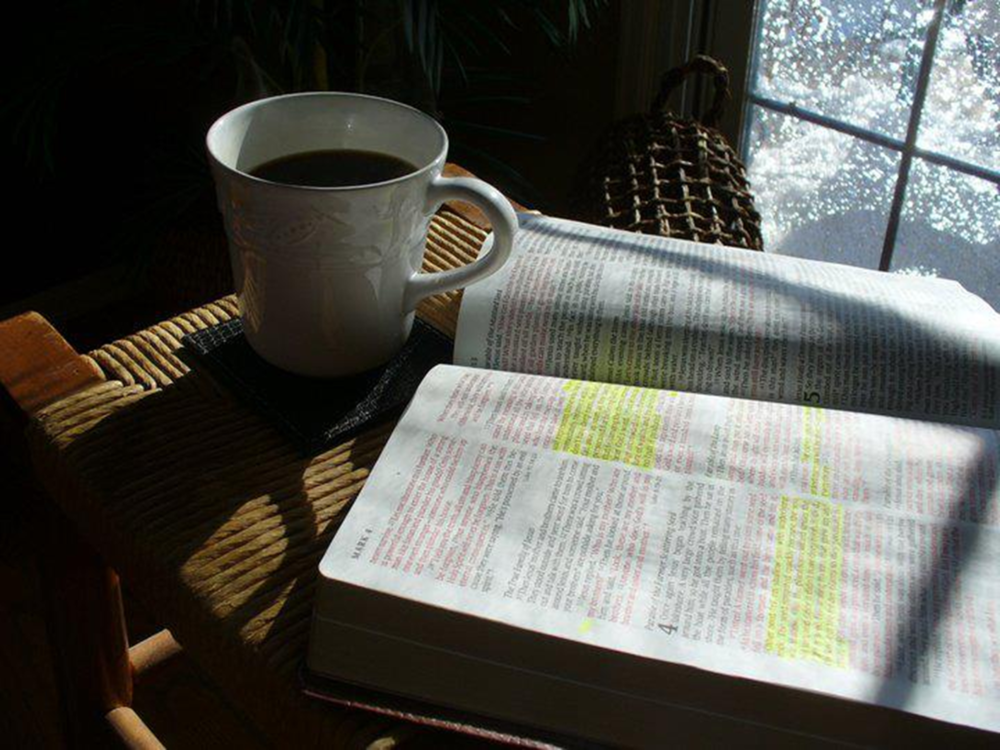
 My Morning Meal