Image Bearers

Created in His image. Now that’s something to chew on.

Then God said, “Let Us make man in Our image, after our likeness. And let them have dominion over the fish of the sea and over the birds of the heavens and over the livestock and over all the earth and over every creeping thing that creeps on the earth.” So God created man in His own image, in the image of God He created him; male and female He created them.

(Genesis 1:26-27 ESV)

When God created man, He made him in the likeness of God. Male and female He created them, and He blessed them and named them Man when they were created.

(Genesis 5:1b-2 ESV)

And for your lifeblood I will require a reckoning: from every beast I will require it and from man. From his fellow man I will require a reckoning for the life of man. Whoever sheds the blood of man, by man shall his blood be shed, for God made man in His own image.

(Genesis 9:5-6 ESV)

As I continue to venture into the book of beginnings it would seem that, among the foundations being laid for the redemption story, us being created in the image of God is kind of important. If repetition in these opening chapters of Genesis is meant to drive anchors into the bedrock of our faith, then, along with God being established as Creator, that we were created in His image has profound implications.

Among those implications, as image bearers of God it isn’t good for us to be alone (Gen. 2:18). God has never been alone. From eternity past He has known the sweetness of fellowship within His triune being. As the definition and source of love (1Jn. 4:8, 16), God has always had the opportunity to “be Himself” as the Father has loved the Son since before the foundation of the world (Jn. 17:24 ESV). Thus, creating something in His likeness, God created something wired for communion. Wired to be loved. Wired to love.

What’s more, as I read in Genesis 9 this morning, because God created male and female in His likeness, there is also an intrinsic value placed on them as image bearers. Apart from having ever done anything, or even being able to do anything, simply because they are image bearers they are set apart. Elevated in status above the rest of creation. To have dominion over every living thing. Their life highly regarded above every living thing. Worthy of protection. Of whom, the shedding of their blood demands a reckoning. And why? For God made man in His own image. That fact alone demands respect for every human being.

But what of image bearers in rebellion? Of those made in the likeness of God seeking instead to be like God? Of those created for communion with the Creator choosing instead to worship the creation rather than the Creator? What are the image bearing implications then?

“For God so loved the world, that He gave His only Son, that whoever believes in Him should not perish but have eternal life.”   ~ Jesus

(John 3:16 ESV)

How big a deal is to be made in the likeness of God? So big that God would send His Creator Son to take on creation’s weakness in order to redeem those created to bear His image. His blood shed because of our sin. The reckoning for our death-causing transgression laid upon Him so that we might be reconciled with our image bearing purpose. New creations, with a new heart, a new life, and a new power, replacing the old man’s corrupted likeness of God. A new work begun in us through the Spirit of God. His Spirit conforming us to the image of His Son that we would again bear the likeness of our God as we were designed to (Rom. 8:29).

Created in His image. Kind of a big deal? I’m thinkin’ . . .

Big enough to unleash unfathomable grace.

For our good and for His glory!

Posted in Genesis | Tagged , | Leave a comment

The Creator Who Makes Things Very Good

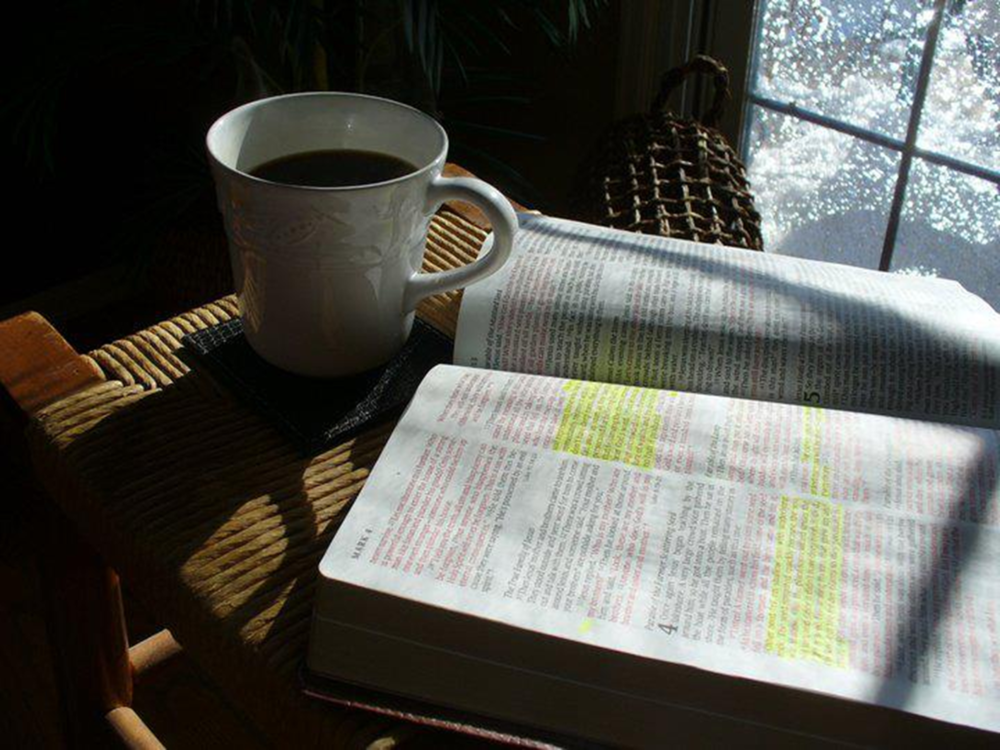
After a great week with my kids and grandkids, it’s also kind of great to be back at my desk this morning. Opening a new bible, preparing a new copy of my reading plan, putting my bookmarks in place, sharpening my colored pencils, and anticipating another year, Lord willing, of feeding on His word in the morning.

I read the cover of my reading plan and let the words sink in: “In the year ahead, ask God each day to speak directly to you from the Scripture portions you read. Be expectant, and let your continual exposure to God’s Word reshape your attitudes and behavior as you gain a better understanding of every part of His written testimony to us.”

Expectant. That’s the word. Expecting an encounter of the divine kind each time I open His Word. Believing that as I read and meditate I am being transformed by the renewing of my mind. Engaging in His work of conforming me to the image of His Son. Expectant.

And as I hover over my readings this morning what I’m reminded of is that my God is a creating God.

God’s creative nature clearly revealed in Genesis as He makes the heavens, the earth, and everything on the earth. His fingerprints of bringing things, even things without beginning, into being as I read in the opening verses of Matthew the birth story of the Savior through a meticulously engineered genealogy and a miraculously conceived child. His creative nature appearing again in Acts as there I find the beginnings of the eternally prevailing church of Christ.

Our God is a God who creates. And, praise be to God, a God who, with abundant grace, re-creates.

And what God makes . . . He makes good!

And God saw everything that He had made, and behold, it was very good.

(Genesis 1:31 ESV)

I’m chewing on the rhythm of creation. God determines. God declares. God deliberates.

The Creator determines to create. Taking a mass without form and void of life and systemically shaping and populating it. Making a world alive with creatures and people He desires to interact with.

He then declares His creation into being. Repeatedly God says, “Let there be . . .”

And then–and this is what has really grabbed me this morning–God pauses and deliberates. He reflects and contemplates over what He has just created and whispers, “It is good.” On the sixth day even more so. After all has been made, delighted, He nods His head and proclaims, “This is very good!”

God is a creator and what He creates is good, very good. And though marred by the fall, though corrupted by man’s disobedience and transgression, God determined to redeem, restore, and reconcile His sin-assaulted creation. And that through a new creation. And that through His Son, the Word who was in the beginning, the Word who is the Maker of all things (Jn. 1:1-3).

Therefore, if anyone is in Christ, he is a new creation. The old has passed away; behold, the new has come. All this is from God, who through Christ reconciled us to Himself . . .

(2Corinthians 5:17-18a ESV)

In Christ? Then I’m part of the new creation.

Imperfect? Yup. Still trying to figure out this pilgrim way? You know it! Not there yet? Yes sir!

But good? Even very good? I’m thinkin’ . . .

Not because of who I am or what I’ve done, but because of who He is, the Creator who makes everything He makes very good.

I’m His work in progress. Possessor of the promise that the work He has begun in me He will complete (Php. 1:6). Confident that He is able to present His bride to Himself “in splendor, without spot or wrinkle or any such thing, that she might be holy and without blemish” (Eph. 5:27).

Created to be very good. Very good in Christ. Very good through Christ. Very good for Christ.

All through over-flowing and all-sufficient grace. All for His glory.

Amen?

Posted in Genesis | Tagged , , | 1 Comment

You Come Too!

Not gonna lie, there’s something satisfying about finishing up my reading plan each year. And it’s not so much a feeling of self-satisfaction. But it’s the kind of satisfaction you experience after having consumed a great meal at a great banquet put on by a great host. From appetizer to dessert it has been an experience. Memories of the different tastes and flavors linger as you push away from the table, lean back, stretch out your legs, and rub your belly. Fed full and satisfied.

This Book is a feast. Quality (not just quantity) food for the soul. Nothing bland about it. Every course unique. The overall story, however, amazingly cohesive and tied together.

I’m anticipating that next week will be hard to maintain routine as we all head up to the homeland to hang out together for a few days celebrating the birth of our Savior and reflecting on the many reminders of the goodness and faithfulness of our Father. So this morning, I’m savoring the last bites of this great feast I’ve enjoyed over this past year. And the last taste I get from the Book is the promise reminding me that, surely, Jesus is coming soon!

And he said to me, “These words are trustworthy and true. And the Lord, the God of the spirits of the prophets, has sent His angel to show His servants what must soon take place.” “And behold, I am coming soon. Blessed is the one who keeps the words of the prophecy of this book.” . . .

“Behold, I am coming soon, bringing My recompense with Me, to repay each one for what he has done. I am the Alpha and the Omega, the first and the last, the beginning and the end.” . . .

He who testifies to these things says, “Surely I am coming soon.”

(Revelation 22:6-7, 12-13, 20 ESV)

There’s a lot up for debate when it comes to the prophetic visions John saw and recorded in this book. But one thing is crystal clear. The promise repeated three times in these closing verses. Jesus is coming again . . . and soon!

And the satisfaction of having consumed this present meal pales with the anticipation of a coming day. Knowing that the food of faith served up on this small desk each morning one day will give way to a marriage supper hosted in heaven at a massive table by the Lamb Himself. That what the Spirit brings to the imagination each morning, the Son will soon display before our eyes for all eternity.

For we shall behold Him! For surely He’s coming soon!

And so the Spirit and the Bride say, “Come!”

The one who has ears to hear says, “Come!”

All God’s people cry, “Amen. Come, Lord Jesus!”

And so, ending another year by anticipating a new year that could be the year when we see Him face to face . . . and having tasted and seen the Lord is good and thus hungering for the full-meal deal . . . we respond afresh to His invitation:

And let the one who is thirsty come; let the one who desires take the water of life without price.

(Revelation 22:17b ESV)

Having been reminded that He is coming soon, we resolve, by His enabling, to come even now. Bringing our thirst, knowing anew that He will satisfy it with His flowing river of life. Without price, remembering again He has paid for it, once for all, through the flowing fountain of His blood.

And so, even as we cry, “Come, Lord Jesus!” His Spirit speaks to ours whispering, “You come too!”

And this too evidence of His eternal grace. And this always for His everlasting glory.

Posted in Revelation, Uncategorized | Tagged , , , | 1 Comment

Behold the Lamb . . . Forever!

I’m reading the second to last chapter in the Bible this morning. The end of the story, the beginning of eternity. And what strikes me is the number of times John, in his prophetic heavenly vision, refers to “the Lamb.” Five times Jesus, the King of kings and the Lord of lords, is seen as the Lamb in this chapter.

And you’d think at this point, the Lamb motif could be done. That the divine persona reminding us of Jesus dying on a cross could be retired. After all, the sacrifice was once for all, the work finished, the Son resurrected in power and glory, His glorious appearing a reality. Yet, John looks at the One in the midst of the throne and . . . still the Lamb.

In fact, though you might expect that Jesus as the Lamb would be most often mentioned in gospels, it isn’t. John is the only gospel which “beholds the Lamb”–and that only twice (Jn. 1:29, 1:36). But when John beholds the Lamb in Revelation, it occurs some twenty-four times! Jesus is the Lamb forever!

And chew on it a bit, and you perhaps understand why. Without the Lamb and His sacrifice there is no eternity for anybody. Apart from the Lamb slain from the foundation of the world (Rev. 13:8), there is no salvation. Without the shedding of blood there are no names written in the Lamb’s book of life (Rev. 21:27).

And so we behold the Lamb, and will behold the Lamb forever.

Meditating on this, the thought of forever the Lamb seemed familiar. A vague recollection that this wasn’t the first time I had been struck by this. Sure enough, back in December 2009, I was moved to wonder and worship at finding, again and again, the Lamb in heaven.

I know it makes this a pretty long post, but thought I’d include those 2009 thoughts as a morning meal supplement.

Behold the Lamb . . . forever!!!

By His grace. For His glory.

————————–
Forever the Lamb

It occurs to me this morning that when Jesus “made Himself of no reputation” and took “the form of a bondservant” and came “in the likeness of men” . . . when He let Himself be “found in appearance as a man” and “humbled Himself and became obedient to the point of death, even the death of the cross” (Php. 2:7-8) . . . that He was entering into an eternal humility. This was not some temporary identification with the lost creation, but was an act that would define Him throughout eternity.

I’m reading Revelation in 5 this morning. The Omnicolor glow of Revelation 4 is still fresh as a scroll appears in the hand of “Him who sat on the throne.” The Almighty lifts up the scroll and an angel’s voice echo’s throughout heaven, “Who is worthy to open the scroll and to loose its seals?” (5:2). And no one, at first, steps forward . . . no one in heaven or on the earth or under the earth was able to open the scroll . . . or even look at it (5:3). But then, behold the Lion of the tribe of Judah, the Root of David . . . He has prevailed . . . He is worthy to take the scroll and unveil its justice (5:5).

And that’s what you kind of expect of Messiah, isn’t it. A Lion . . . mighty . . . powerful . . . awesome to behold. A King . . . after the line of David . . . majestic . . . Possessor of all authority . . . indisputable right to reign. That’s my Lord! But when John looks upon Him, what does he see? “And I looked, and behold, in the midst of the throne and of the four living creatures, and in the midst of the elders, stood a Lamb as though it had been slain . . . ” (5:6).

There in the middle of the glory of heaven . . .with the throne upon which Almighty God is seated, surrounded by winged beasts declaring His holiness, on one side, and the face-planting, worshiping elders on the other . . . in the middle of it all stands the Lion of Judah . . . the Root of David . . . the image of the invisible God . . . the One by whom all things were created . . . the One in whom all things consist . . . the One who is the head of the church . . . the One whom the Father has determined would have the preeminence in all things (Col. 1:15-18) . . . and how is He seen? . . . as a Lamb as though it had been slain.

What does that look like? Physically I know that His face was beaten beyond recognition . . . that His back was laid open with a scourge . . . that His hands and feet were violated with spikes driven through them . . . that His side was pierced with a spear. Yes, He was wounded for our transgressions, and bruised for our iniquities (Isa. 53:5), but you’d think that after being resurrected . . . that after ascending to heaven . . . that after having taken His place at the right hand of the Majesty on High . . . that this would somehow be behind Him and He would “go back” to being King of kings and Lord of lords. But, just as He never stopped being the Lion of Judah or the Root of David when inhabited flesh for 33 years, so too, He has taken on Himself an eternal humility as the Lamb that was slain. The King of kings will always be the Lamb that was slain.

And when we behold Him . . . for sure, we will see His majesty . . . we will recognize His power . . . but, we will also behold Him as the Lamb. Visibly, throughout eternity, He will be recognized as the One that was slain. Forever, when we look upon Him, there will be a facet of His being that reminds us of the love of God. Heaven, in all it’s omnicolor glory will not shield the reality of the price paid that we might be purchased for Him . . . nor will we want it to. For it will be blessing beyond imagination to hear “the voice of many angels around the throne, the living creatures, and the elders; and the number of them was ten thousand times ten thousand, and thousands and thousands, saying with a loud voice, ‘Worthy is the Lamb who was slain to receive power and riches and wisdom and strength and honor and glory and blessing!’ ” (5:12)

Oh, the eternal humility of Christ . . . forever the Lamb that was slain . . . forever the object of our worship . . . “Blessing and honor and glory and power be to Him who sits on the throne, and to the Lamb, forever and ever!” (5:13) . . . amen!

Posted in Revelation | Tagged , , , , | Leave a comment

My Servant

The storm was over. The throbbing pain of sore infested limbs had ended. The pounding sorrow of having lost family, fortune, and his fair name had subsided. The relentless waves of accusation after accusation by his miserable comforters had ceased. The whirlwind of God’s face to face correction had calmed. Certainly there had been weeping for a night, but joy was to come in the morning–the latter days of Job blessed by the LORD more than his beginning (Job 42:12).

And as I hover over the closing chapter of Job this morning what strikes me is that, when all was said and done . . . and done and said . . . Job had never ceased being the LORD’s.

After the LORD had spoken these words to Job, the Lord said to Eliphaz the Temanite: “My anger burns against you and against your two friends, for you have not spoken of me what is right, as My servant Job has. Now therefore take seven bulls and seven rams and go to My servant Job and offer up a burnt offering for yourselves. And My servant Job shall pray for you, for I will accept his prayer not to deal with you according to your folly. For you have not spoken of me what is right, as My servant Job has.”

(Job 42:7-8 ESV)

My servant Job. Repeated four times. The awesome God of creation making it clear for all who have ears to hear that, though Job’s frustration and vexation spilled over into arrogant demands for arbitration and, as such, required a much needed confrontation, Job was still God’s guy.

Though the clay had raised his voice to the Potter, he never stopped being a vessel molded in order to show the riches of the glory of the Molder (Rom.9:19-24). Though the crucible of suffering had revealed dross in his heart, it was so that the faithful Refiner might present Job “without blemish in the midst of a crooked and twisted generation”, shining as light in the world (Php. 2:14-15). Through it all, Job never stopped being God’s servant.

Even as I chew on that relationship, that of a servant, I’m reminded of what privilege it is to be a servant of God.

For a day in Your courts is better than a thousand elsewhere. I would rather be a doorkeeper in the house of my God than dwell in the tents of wickedness.

(Psalm 84:10 ESV)

But then, I remember too that we have been counted as so much more than servants.

“No longer do I call you servants, for the servant does not know what his master is doing; but I have called you friends, for all that I have heard from My Father I have made known to you.”   ~ Jesus

(John 15:15 ESV)

Not just servants, friends.

And not even just friends but so much more.  Redeemed that we might receive adoption as His children. God having sent the Spirit of His Son into our hearts, crying “Abba Father!” Thus, no longer slaves–through we gladly submit and serve as such–but instead a son, a daughter, and, as such, an heir through God (Galatians 4:6-7)

Always His servant. Forever friended by Jesus. Never not being owned as a child of God. Even through the storm. Even when we go where we shouldn’t. Even when we cross the line.

Our God promising to complete the work He has begun in us (Php. 1:6).

Our God determined to raise up people purchased by the blood Jesus, and fashioned into the likeness of Jesus, so that He might proclaim, “Have you consider My servant!”

Only by His grace. Always for His glory.

Posted in Job | Tagged , , , , , | Leave a comment

Untamable

I wonder if our familiarity with the Nativity doesn’t have, if not a damaging effect, sometimes a dulling one. That we can look in the manger, see the Baby, and subconsciously think to ourselves, “That’s a manageable God.”

We behold Him in His humanity and somehow think there’s a degree of equality. Having “emptied Himself” of His eternal majesty and power, “taking the form of a servant, being born in the likeness of men” (Php. 2:7), because He presents Himself less than He really is, we think of ourselves more than we really should.

But a couple of readings this morning destroy that notion. Reminding me that my God is untamable.

One of those readings was in Revelation 19. There we see the heavens opened and the one called Faithful and True ready to make war against the enemies of God on earth.

His eyes are like a flame of fire, and on His head are many diadems, and He has a name written that no one knows but Himself. He is clothed in a robe dipped in blood, and the name by which He is called is The Word of God. . . . From His mouth comes a sharp sword with which to strike down the nations, and He will rule them with a rod of iron. He will tread the winepress of the fury of the wrath of God the Almighty. On His robe and on His thigh He has a name written, King of kings and Lord of lords.

(Revelation 19:12-16 ESV)

Nothing silent about this night. Nothing calm. Nothing bright. Not so tender. Not so mild. The Babe in the manger is the Warrior of heaven. King of kings and Lord of lords.

But it was chewing on Job 41 this morning that really got me thinking about our untamable God. There God is addressing Job who has been begging to go toe-to-toe with the Almighty over his unfair circumstances (though, had Job really thought about the implications of going one-on-one with the “All Mighty,” he might have cooled his jets a bit). And God says, in effect, “Face off with Leviathan first.”

After God reminds Job that He is God of all creation, with power over every living creature, God draws Job’s attention to one creature in particular, Leviathan. Don’t know the exact identity of this beast, but think a cross between the biggest, meanest croc you can imagine and a fire-breathing dragon.

Not to be found in a merchant’s market because it’s next to impossible to trap, contain, or kill the beast. Its skin impervious to harpoons and spears. Its teeth a terror. When he raises himself up the most mighty of men shake in their boots. When he starts to thrash they are beside themselves.

“Can you put a rope in his nose or pierce his jaw with a hook? Will he make many pleas to you? Will he speak to you soft words? Will he make a covenant with you to take him for your servant forever? Will you play with him as with a bird, or will you put him on a leash for your girls?”

(Job 41:2-5 ESV)

Will you put him on a leash for your girls? That’s the phrase that caught my attention. (I wonder why?) That’s the thought that led me to read Job 41 over a couple of times.

Bottom line? You don’t mess with Leviathan. Lay your hands on him, it won’t happen again. To look at him will be to drop in dread. So fierce that no one dares even stir him.

“Who then is he who can stand before Me?” ~ God    (Job 41:10b ESV)

If a mere creature is so untamable, then what of its Creator? If what was spoken into being is beyond our power to domesticate, then what of the One who did the speaking?

It makes the wonder of Immanuel, God with us, all that more wondrous. The awe of the Christ child, in whom “all the fullness of God was pleased to dwell” (Col. 1:19), all that more awesome.

And while it makes Him, in a sense, all that more accessible, beware lest we think Him governable.

He is accessible not because He is any less God, but because of the steadfast love that compelled Him to pursue a wayward people, coming in flesh, coming to serve, coming to offer His life as a ransom for many, in order to provide us a way into His holy presence.

So, while our God has made Himself approachable, He is still untamable.

O, let us enter into the holy of holies by the blood of Jesus. And let us worship Him in the splendor His might and power.

And this, by His grace alone. And this, for His glory alone.

Posted in Job, Revelation | Tagged , , , , | 1 Comment

The Fault Line

It would seem there are some lines you just don’t cross. Some boundaries you might walk up to the edge of but best go no farther. Some things that might be fair game but you better know when you’re out of bounds. As I’m getting to the end of the book of Job, I think the Spirit has shown me one of those lines.

Fact: Job was righteous unlike anyone around him. Three times in the opening scenes which set up the drama of Job vs. his friends, it’s stated that Job was “a blameless and upright man, who fears God and turns away from evil” (1:1, 8; 2:3). Twice that fact is testified to by God Himself who adds a big exclamation point to the assessment by also stating “there is none like him on the earth.”

Thus, when Job is defending his righteousness before His accusers . . . ahem, excuse me, I mean “comforters” . . . I’m thinking he’s got a leg to stand on.

So, where’s the line Job crossed from being put on a pedestal by God in the opening chapters of the book, to being put in his place by God in the final chapters of the book? Seems it’s the fault line.

And the Lord said to Job: “Shall a faultfinder contend with the Almighty? He who argues with God, let him answer it. . . . Dress for action like a man; I will question you, and you make it known to Me. Will you even put Me in the wrong? Will you condemn Me that you may be in the right?”

(Job 40:1-2, 7-8 ESV)

Faultfinder. That’s the word that caught my attention. That’s what I’m chewing on this morning. That’s the line I think Job crossed.

When everything Job possessed or held precious was stripped away, he blessed the name of the LORD and “did not sin or charge God with wrong” (1:20-22). Even when he was struck with “loathsome sores from the sole of his foot to the crown of his head” and his wife counseled him to “Curse God and die!” he did not sin with his lips (2:7-10). But as time wore on, as his despondency at having ever been born deepened, as his confusion over how life for the righteous could go so wrong, he did charge God with wrong. And, it would seem, he did sin with his lips. He became a faultfinder. And he crossed the fault line.

Job found himself taking the place of God’s reprover. God’s great contender. Becoming far too familiar with God as His faultfinder. Ready to enter the courts of heaven to present his case, confident God would be weighed in the balance and come up short with any sort of justification for Job’s unjust circumstance.

Job’s pain and suffering pushed him to questioning God’s person and sovereignty. His confusion led him to impugn God’s character. His righteous reputation, true as it was, tripped him up as He questioned God’s righteous nature. Job assessed God’s behavior in the context of his circumstance rather than placing his pain within the context of God’s promises. His physical suffering was a catalyst for a spiritual battle.

Not judging Job. Relating. Realizing the reality of the fault line and how easy it could be to cross it. Seeing how close I can be to becoming a faultfinder. Assessing my propensity to start with my situation and fit God onto it, rather than taking every thought into captivity and considering my circumstance in the light of what I know to be true concerning God’s holy, righteous, loving, and faithful character.

O that I might be kept from any temptation to contend with God. That I wouldn’t even think of reproving Him. Don’t wanna be a faultfinder. Don’t wanna cross the fault line.

Instead, being conformed increasingly into the image of the One who was the only truly upright and blameless Man, that I would, in every circumstance, always know that God is faithful. That His purposes are pure and His promises are sure.

By His grace. For His glory.

Posted in Job | Tagged , , , | 1 Comment

Cloths — In Birth and In Burial

Met with a friend yesterday, a buddy I try to connect with regularly to talk about what he’s been reading in the Word. Yesterday we spent a few minutes on 1Corinthians 15 and the resurrection. If Christ has not been raised from the dead, then our faith is in vain (1Cor. 15:14). And though there have been those who have tried to put forth a theory that Christ didn’t really die on the cross, but just swooned and later revived, from John’s testimony in His gospel, I’m pretty sure the One who hung on the cross that day did so until all were satisfied that He was dead.

Jesus said Himself, “It is finished” and bowed His head and gave up His spirit (Jn. 20:30). His executioners, well versed in how to kill a man by crucifixion, saw that He was dead and so determined no reason to break His legs to hasten the process (20:31-33). One of them, for good measure and to provide empirical proof, (kind of like cutting into a roast to make sure it’s done), pierced Jesus’ side with a spear “and at once there came out blood and water” — further proof that the man on the middle cross had breathed his last (20:34).

And should there be any doubt, Joseph of Arimathea and Nicodemus came and took the body, slathered it with 75 pounds of burial spices and wrapped it in linen cloths. Any life left would have been smothered. But they too knew He was dead and so they prepared His body for burial and laid it in a tomb.

Jesus was dead. It was over. All that was left, or so most thought, was for Him to return to the dust. And so, that He was seen three days later by the disciples, that He was seen by hundreds over the next few weeks before His ascension, was glorious proof that truly the work was finished. Sin atoned for. Death defeated. Our faith so not in vain!

And this morning I continue to chew on the juxtaposition of His death with His birth. This morning’s focus? My Savior wrapped in cloths.

And while they were there, the time came for [Mary] to give birth. And she gave birth to her firstborn Son and wrapped Him in swaddling cloths and laid Him in a manger, because there was no place for them in the inn.

(Luke 2:6-7 ESV)

So [Joseph of Arimathea and Nicodemus] took the body of Jesus and bound it in linen cloths with the spices, as is the burial custom of the Jews.

(John 20:39-40 ESV)

In birth and in burial my Lord was wrapped in cloths.

Cloths to keep the Baby warm. Cloths because the Man was dead. Lovingly swaddled by a mother full of wonder as to what His miraculous birth should mean. Quickly sheathed by disillusioned disciples trying to delay the stench of death, wondering what His life had been for.

Immanuel, God with us, wrapped in cloths because He was born into His creation’s world. Jesus, the Son of God, wrapped in cloths because He had been put to death at His creation’s hand.

The first, a scene which through the ages has evoked a sense of peace, hope, love, and joy. The second, a scene of confusion and apparent defeat.

But then came the morning. When the cloths were shed and the Savior rose again.

The morning which fulfilled the hope of that first Christmas morning. The morning which points to another dawn breaking when He returns in glory, majesty, and power. Another morning when of cloths. When “He is clothed in a robe dipped in blood, and the name by which He is called is The Word of God” (Rev. 19:13 ESV).

And we shall behold Him!

See Him in cloths in the manger. Remember Him in cloths in the tomb. Anticipate His return in cloths of righteousness and redemption.

O come let us adore Him!

Because of grace. For His glory.

Posted in John | Tagged , , , , | Leave a comment

Woman, Behold Your Son

It’s an annually occurring juxtaposition. Every December I wrap up my reading plan chewing on the death of Jesus at a time of year when so much around me draws my attention to His birth.

Solomon said that “for everything there is a season, and a time for every matter under heaven” and that one of those things is “a time to be born, and a time to die” (Eccl. 3:1-2). True for every man and woman. True too for the One who divested Himself of His heavenly glory and power, and determined to fully enter into the human experience. There was a time for Jesus to be born. And, by the Father’s will, a time for Jesus to die.

Though it was the same Jesus, and though the two events were only 33 years apart, in so many ways so many things had changed so dramatically. The anticipation of that silent night giving way to the condemnation of an angry crowd early one morning. The loud song of an angelic host before lowly shepherds, giving glory to God and declaring the birth of a Savior in the city of David, silenced by shouts of “Crucify Him, crucify Him” by stiff-necked chief priests and officers before the most powerful man in Jerusalem.

The Son of God lying in a manager receiving gifts of gold, frankincense, and myrrh from worshiping wise men, a faint memory as the Lamb of God hung on a cross and was offered but sour wine by indifferent soldiers who just wanted to get the job over with.

But one thing hadn’t changed. One thing is strikingly similar between the idyllic scene around the manger and the chaotic circus around the cross. The mother of Jesus was nearby.

When the soldiers had crucified Jesus, they took His garments and divided them into four parts, . . . This was to fulfill the Scripture which says, “They divided My garments among them, and for My clothing they cast lots.” So the soldiers did these things, but standing by the cross of Jesus were His mother and His mother’s sister, Mary the wife of Clopas, and Mary Magdalene. When Jesus saw His mother and the disciple whom He loved standing nearby, He said to His mother, “Woman, behold, your son!”

(John 19:23-26 ESV)

Oh the contrast between the image evoked by the multiple nativity scenes set up in my home and the picture formed in my mind’s eye as I read in John this morning. The first of a peace filled virgin. Cradling her son as she meditates on angel declared prophecies and shepherd delivered messages. Treasuring up all these things, “pondering them in her heart” (Lk. 2:19). The other of a distraught mother, looking with horror on her derided, naked, and beaten son. Trying to make sense of everything He had told them as she watched Him die.

“Woman, behold, Your Son!”

See Him as the Light of the world come to deliver men from darkness. But know that, though He came to His own, His own received Him not. Marvel that the King of kings should come into the world in such lowly manner, and then try and make sense of the darkness that compelled His people to declare they would have no king but Caesar.

Wonder at the Savior born that night, lying in a manger, the hope of the world. Try and comprehend Him suffering as He hung on a cross, the Lamb of God, slain as the final sin offering, the once for all Atonement for the world.

Woman, behold, Your Son!

She was there that holy night. She was there that horrific morning.

And Jesus saw her. And He knew her.

Born by her, He would die for her.

The grace of God incarnate. The glory of God manifest.

Hallelujah! What a Savior!

Posted in John | Tagged , , , | Leave a comment

It Wasn’t Enough

Give them blood, he thought, and that should appease them. A good beating, flayed so they can see muscle. Surely that would satisfy their illogical, unjustifiable animosity. And then add some mockery for good measure. Thinks He’s a king? Then we’ll present a king–a crown of thorns driven into His brow, a purple robe draped over His beaten body. That should be enough.

It wasn’t.

Then Pilate took Jesus and flogged Him. And the soldiers twisted together a crown of thorns and put it on His head and arrayed Him in a purple robe. . . . Pilate went out again and said to them, “See, I am bringing Him out to you that you may know that I find no guilt in Him.” So Jesus came out, wearing the crown of thorns and the purple robe. Pilate said to them, “Behold the Man!” When the chief priests and the officers saw Him, they cried out, “Crucify Him, crucify Him!”

(John 19:1-6a ESV)

That Pilate didn’t want to crucify Jesus is evident. Three times he pronounces his verdict to the mob, “I find no guilt in Him” (Jn. 18:38; 19:4, 6). Not that Pilate was overly constrained by truth. After all, what is truth? Not that he believed right and wrong out-ranked self-protecting power. But hey, why crucify someone who’s innocent if you don’t have to?

So it seems like, rather than punishing Jesus for some alleged crime, Pilate was more interested in trying to placate the priests. Give them enough destruction that they’d forget about demanding death. Enough gore that maybe they might even feel a twinge of guilt. Enough blood so that they’d back off. But it wasn’t enough.

And as I chew on this showdown in Pilate’s court, I’m reminded afresh that it really wasn’t enough. That, had Jesus only suffered at the hands of men, His mission would have come up short.

For it wasn’t about appeasing a maniacal mob. Instead, it was all about satisfying the wrath of a holy and just God. And, for that, Jesus would need to die.

. . . without shedding of blood there is no remission. . . . so Christ was offered once to bear the sins of many.   (Hebrews 9:22b, 28a ESV)

What wages were owed for my sin? What price needed to be paid for my redemption? What sacrifice would be required for my deliverance?

The humiliation of the One by whom all things were created wouldn’t do it. The flogging of the Father’s beloved and well-pleasing Son couldn’t do it. But only the Lamb of God, offered once for all for the transgressions of all people, could make atonement for sin and a way of reconciliation for sinners.

“The Son of Man must suffer many things and be rejected by the elders and chief priests and scribes, and be killed, and on the third day be raised.”  ~ Jesus

(Luke 9:22 ESV)

That day wasn’t about some despot’s lame attempt at subduing a crowd’s bloodlust. It was about a vessel of God, being compelled to make an offering to God, to satisfy the wrath of God, that we might know peace with God. And this through the death of the Son of God.

It was about Jesus, come as a babe in the manager, dying for my sin. And it was enough!

What wondrous grace! To God be the glory!

Amen?

Posted in John | Tagged , , , | Leave a comment