
I’ll take well known people in the book of Acts for 500, Alex?
This man is the most renown of the seven chosen to address
the problem which arose with the Hellenist widows.
Who is Stephen?
Correct.
Luke describes this man as being “full of the Spirit and of wisdom”,
“a man full of faith”, and a man “full of grace and power.”
Who is Stephen, again?
Yessir.
This guy is called “angel face”.
Huh?
This morning I’m hovering over the last verse of Acts 6.
Acts 6, the chapter that lets us know that even among the born again there can be blow ups. The chapter that hints at the principle that church leaders are meant to serve by leading and that others are called by the church to lead by serving. The chapter that tells us that the character qualities for those who “serve tables” are somewhat alike to those who are to devote themselves “to prayer and to the ministry of the word.” The chapter that introduces us to Stephen. The chapter that introduces us to “angel face.”
After faithfully teaming with the other six to resolve the issue of discrimination in the widow’s dining hall, the Lord leads Stephen to go solo “doing great wonders and signs among the people” as he testifies of the risen Christ. And it draws the attention of opponents who are so bent out of shape they conspire to falsely accuse him of grievous misconduct and bring him before “the council.” And what does this tribunal see when this man full of the Spirit, and of wisdom, and of grace is brought before them? You guessed it. They see angel face.
And gazing at him, all who sat in the council saw that his face was like the face of an angel.
(Acts 6:15 ESV)
What a curious thing for Luke to include in his account. And yet, “all Scripture is breathed out by God” (2Tim. 3:16) and what Luke wrote he wrote as he was “carried along by the Holy Spirit” (2Peter 1:21). So, that Stephen’s face was like the face of an angel must be important. How come?
There was something in Stephen’s countenance, as he stood before those who would accuse him and those who would judge him, that was noticeable. I don’t know that Stephen’s face literally shone as did Moses’ face (Ex. 34:29), though given how the Spirit was manifesting His power through Stephen, it might be considered an encounter of the divine kind similar to Moses’ one-on-one with God on Mt. Sinai. Hang out in the presence of holiness and glory and, it seems, some of it may just rub off on you . . . literally.
But if it wasn’t a visible aura, I wonder if what they saw in angel face was an intangible assurance. A coolness, a calmness, a composure. The same thing seen a few chapters back when the Jewish leaders in Jerusalem “saw the boldness of Peter and John” and “recognized that they had been with Jesus” (Acts 4:13). Something about engaging with the Trinity — Father, Son, and Holy Spirit — that etches itself not necessarily upon one’s countenance but through one’s confidence.
However it was exactly perceived, there seems to be something about rubbing shoulders with majesty that can mark a man. Something about encountering God’s glory that can be detected through an unseen glow in a woman. Something about abiding in the holiness of God that gives off the air of . . . well, of an angel . . . a messenger who dwells in the presence of God and is ready to do the bidding of God.
Hmm . . . something to chew on, I think.
More evidence of God’s grace. More reason to give God glory.
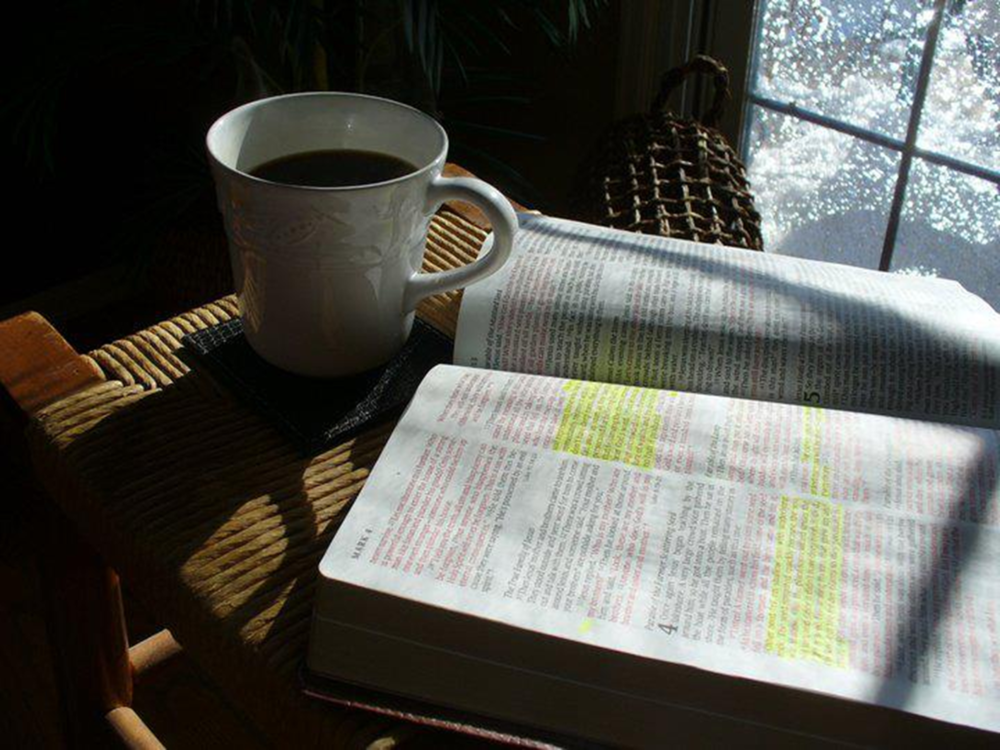
 My Morning Meal
“The chapter that hints at the principle that church leaders are meant to serve by leading and that others are called by the church to lead by serving.”