
A Believing Believer

Paul’s choked. He’s bent out of shape. He’s irritated. Or, to use biblical language, “his spirit was provoked within him” (Acts 17:16). At what? At Athens, a city full of idols. Objects of worship on every street corner. Altars for worship never very far away. High-minded philosophers willing to bow down to the next latest and greatest deity. Religious people who are dead to spiritual realities. And the longer Paul waited in Athens for Silas and Timothy, the angrier he got (MSG).

And, as Paul wanders about a dark city, he comes upon an altar with this inscription: TO THE UNKNOWN GOD.

There it is! That’s “the hook” . . . there’s Paul’s in . . . this is the bridge, the connect point. They recognize an unknown god and Paul says, “Him I proclaim to you” (17:23).

And Paul proceeds to reason with them concerning this God. He identifies their “unknown God” as the Creator of all things . . . including all mankind. So, he reasons, if man is the “offspring” of God, then it’s ludicrous to think that “that the Divine Being is like gold or silver or stone, an image formed by the art and imagination of man” (17:29). Paul further declares that God has said “enough” to this ignorance and has revealed Himself through Jesus, a Man He has appointed to judge the world in righteousness on a day already set; “and of this He has given assurance to all by raising Him from the dead” (17:31).

There it is. From ignorance concerning an unknown God to revelation of His resurrected anointed One. So now what?

And it’s the responses of these philosophers that’s captured my attention this morning.

Now when they heard of the resurrection of the dead, some mocked. But others said, “We will hear you again about this.” . . . But some men joined him and believed . . .

(Acts 17:32, 34a ESV)

Three different responses to divine revelation. Some mocked; some put it off; some believed.

And while these men were responding to the gospel message, I’m thinking it has applicability to any matter requiring faith. I’m thinking that, in this, there is a warning to me.

That, from time to time, I too am presented with truths concerning God that might seem kind of out there or too good to be true. Or truths that I might think are really more applicable for some other believer, but not so much for me. Or portions of God’s word that challenge me, that take me out of my comfort zone and force me to make a decision about whether or not God’s word is to be believed at a “next level.”

And in those instances, I’m thinking, I can respond in one of three ways.

First possible response? Mock it. Make fun of it. Brush it off and make light of it. Hopefully this is a very rare response . . . as in non-existent. But if I’m honest with myself, are there times that I’ve thought, “Might be true for those in bible times, but not for me, now?” Or, “That’s just a pat answer. Only the naïve would bet on such simplistic platitudes?” I’m thinking I need to beware of taking God’s word lightly.

Secondly, and more likely, rather than responding with mockery, I might be prone to just saying, “Hmmm . . . interesting . . . I’ll deal with that later.” Not putting it down, but putting it off. Not brushing it off, but placing it on the shelf. How dangerous can that be? When I start ignoring the voice of God, when my heart is pricked and I just choose to defer it and move on, what might happen then? What are the chances that if I keep turning a deaf ear to God’s voice, eventually He stops talking? Not a good response to presume that, at some more convenient time or season, that then I’ll deal with revealed truth.

Or, my response to the things of God can be like those who joined Paul and believed. To receive truth, believe truth, and act on truth. To be a “verb believer” . . . an active believer . . . one who readily exercises their faith in response to the precepts and promises of God’s word. Who won’t settle for being a “noun believer” . . . someone who just wears the title “believer” because they’ve accepted Christ as Savior.

To be a believing believer.  To be a man of faith.  Ready to hear God’s voice.  Ready to receive God’s word.  Ready to be shaken from my status quo.  Ready to follow.

“I believe; help my unbelief!”      (Mark 9:24 ESV)

By God’s grace . . . for God’s glory.
Posted in Acts, Uncategorized | Tagged | Leave a comment

Making a Memory

Don’t know why, but as I read the familiar story in Exodus 12 this morning, something struck me as kind of odd. The mighty signs and wonders of God through Moses and Aaron have been escalating as has the pressure for Pharaoh to let God’s people go. We’re building to a crescendo . . . a grand, never before seen, crescendo of deliverance. It’s all going to come down to this one night. If I’m Moses, I’m getting anxious. If I’m Aaron, I just can’t wait. And if I’m the people, ENOUGH ALREADY! LET’S GET OUTTA HERE!

But before that night, the Lord takes Moses and Aaron aside and says, I’m planning a feast (Ex. 12:14-20). Really?!?! Is this the time to talk about how to memorialize the significance of this soon approaching night? Couldn’t we do that after we leave Egypt? On the other side of the Red Sea, perhaps? Or as part of giving the Law on Sinai? Or maybe when our feet have actually walked in the land of promise? Evidently not!

No. After giving instructions about a spotless lamb and a necessary sacrifice, . . . after laying out that they were to eat the flesh and apply the blood, . . . after promising that “when I see the blood, I will pass over you”, . . . but before any of it actually happens, the LORD, it seems to me, pauses, looks to the future and says, I want you to remember. In effect, in addition to all that was going to be accomplished on that night, the LORD was also making a memory.

“This day shall be for you a memorial day, and you shall keep it as a feast to the LORD; throughout your generations, as a statute forever, you shall keep it as a feast. . . . And when you come to the land that the LORD will give you, as He has promised, you shall keep this service. And when your children say to you, ‘What do you mean by this service?’ you shall say, ‘It is the sacrifice of the LORDs Passover, for He passed over the houses of the people of Israel in Egypt, when He struck the Egyptians but spared our houses.'” And the people bowed their heads and worshiped.

(Exodus 12:14, 25-27 ESV)

And I’m struck by how important it was to the LORD that the night be remembered appropriately. It was to be a big deal. A week in the making. A week where no one works and everybody gets focused. Not some passing thought or mindless ritual but an intentional, effort demanding, act of remembrance. And not some optional remembrance but a command to be obeyed for generations to come.

Not just that it would memorialize His great power and mighty deeds. Not just that it would mark the start of their new beginning. But that future generations would learn of, and recall the wonder of, their great deliverance and they would worship in wonder before their great Deliverer.

Kind of reminds me of another feast instituted on the eve of another great deliverance. Another pause before a Lamb was slain, to ensure that future generations would not forget. And I’m thinking, about how important the Lord’s Supper should be in our gatherings.

Regardless of how, or how often, we participate in that feast, it should be conducted in such a way that we really are telling the story to our children. It should be taken in such a condition that we are again in awe at the mighty hand of God to save. Our participation should be purposeful, thoughtful, and cloaked in humility as we recall God’s great intervention, at great personal cost to Himself, on our behalf. As the Israelites did just before they sacrificed their Lambs, watched for their deliverance, and then walked out of bondage, we too should bow our heads and worship . . . really worship!

. . . the Lord Jesus on the night when He was betrayed took bread, and when He had given thanks, He broke it, and said, “This is My body which is for you. Do this in remembrance of me.” In the same way also He took the cup, after supper, saying, This cup is the new covenant in My blood. Do this, as often as you drink it, in remembrance of Me.” For as often as you eat this bread and drink the cup, you proclaim the Lords death until He comes.

(1Corinthians 11:23b-26 ESV)

Making a memory . . . until He comes.

To Him be all glory.

Posted in Exodus, Uncategorized | Tagged , , | Leave a comment

Vindication and Sanctification

“Judge me, O Jehovah.” That’s how Young, in his literal translation, renders the opening lyrics of David’s twenty-sixth song. The idea is that of asking a judge or a governor to weigh the evidence of a matter and render a ruling. It calls for the examination and discerning of the facts. It requests a sentence to be pronounced . . . for or against . . . true or untrue. And as I hover over David’s request this morning, it really seems like a risky thing to ask of a holy, holy, holy God who knows all things.

Vindicate me, O LORD, for I have walked in my integrity, and I have trusted in the LORD without wavering.

(Psalm 26:1 ESV)

David’s call for a verdict isn’t concerning his perfection. Instead, He asks the LORD to examine His sincerity.

I have walked in integrity . . . and I have trusted without wavering (v.1). I wash my hands in innocence (v.6) . . . and I shall continue to walk in integrity (v.11).

Not my acts, Lord, I hear David saying, but my aspiration. Not my deeds, but my desire and determination. David presents before the Judge his heart and invites Him to examine it . . . and to examine it thoroughly.

Prove me, O LORD, and try me; test my heart and my mind.

(Psalm 26:2 ESV)

A bit of lexicon lookup and you realize that David’s inviting intense scrutiny. Assay my heart, Lord, as a metal’s purity is determined by fire. Apply the heat of open examination and expose any impurities. Look me through and through. Leave no thought or intent of the heart unexamined. Look in the secret and see if there isn’t sincerity. An authentic desire to pursue You. An honest pleasure in worshiping You (v.6-7). A genuine love for “the habitation of Your house and the place where Your glory dwells” (v.8).

I read David’s petition before Jehovah and I’m reminded of a similar plea in another song of his.

Search me, O God, and know my heart! Try me and know my thoughts! And see if there be any grievous way in me, and lead me in the way everlasting!

(Psalm 139:23-24 ESV)

And the request for examination, the plea for vindication, was not that David might boast before God of his own righteousness. But that, because of his unwavering trust in the faithfulness of God, and his sincere determination to walk in the ways of God, he might know the grace of God to realize his desire. That the work that God had begun in him might be completed. That the nature the Father sought to form in him would be realized.

But as for me, I shall walk in my integrity; redeem me, and be gracious to me.

(Psalm 26:11 ESV)

His integrity would not be enough to fulfill his intention. His strength insufficient for his settled purpose. But he needed to be ransomed and rescued from the weakness of his flesh in order to know the desire of his spirit. He needed the Divine to stoop in kindness and provide the power needed to take his holy determination and produce a holy walk.

Kind of risky asking Jehovah to judge you. But with vindication comes sanctification.

And you gotta think that’s worth it.

All by His grace. All for His glory.

Posted in Psalms, Uncategorized | Tagged , | Leave a comment

Not About Who Am I, All About Who I AM Is

Yesterday our speaker at church talked about the need to ask the Lord to “throw out” people into the harvest. He pointed out that what’s translated as “send out” in Matthew 9:38 has the idea of driving out or casting out. There’s a notion of force or compulsion behind the term. Our speaker shared how his own calling into ministry required some “subtle prompting” by the Lord . . . as in stomped on by a horse and, when that didn’t quite get the pump primed, a slip on the ice and a snap of the leg. As I read about Moses’ calling into ministry, it seems our speaker is in good company.

If you’re like me, hear the name Moses and you immediately think mighty deliverer. From standing on holy ground to standing before a hard-hearted Pharaoh. From standing before a nation as they walk away from slavery to standing before a great sea about to be parted. From standing on a mountain receiving God’s word, to standing before the promised land ready to say good-bye as his people were about to enter. You think great man. You think godly man. And you remember that “there has not arisen a prophet since in Israel like Moses, whom the LORD knew face to face” (Deut. 34:10).

But as I’m reading in Exodus this morning, I’m reminded how Moses, like our speaker, was at first a bit reluctant.

But Moses said to the LORD, “Oh, my Lord, I am not eloquent, either in the past or since you have spoken to your servant, but I am slow of speech and of tongue.” Then the LORD said to him, “Who has made mans mouth? Who makes him mute, or deaf, or seeing, or blind? Is it not I, the LORD? Now therefore go, and I will be with your mouth and teach you what you shall speak.” But he said, “Oh, my Lord, please send someone else.”

(Exodus 4:10-13 ESV)

The calling was clear (Ex. 3:1-11). A burning bush has a way of getting someone’s attention. As Moses felt the warmth on his face and the ground heating up under his feet, he was all ears when God said, “Come, I will send you to Pharaoh that you may bring my people, the children of Israel, out of Egypt.” But God, responds Moses, can’t someone else pick up the plan You’ve set out for me?

And this is where I so connect with Moses this morning. His first response is “Who am I?” God, he says, I don’t think I have what it takes to go before Pharaoh. I’ve got some baggage with the leadership in Egypt. I might even still be on their “Most Wanted” list. Beyond that, I’m not sure I have what it takes when it comes to addressing those in powerful positions.

I can kind of get where Moses is coming from. Who am I?

But Moses asks the wrong question when he asks, “Who am I?”. It’s not about who am I, but all about who I AM is.

Israel’s deliverance wasn’t going to happen because Moses was eloquent of speech . . . or impressive in stature . . . or charismatic in nature. His call to the harvest wasn’t about who he was. It was all about who His God is and what His God had determined to do.

“I am the LORD, and I will bring you out from under the burdens of the Egyptians, and I will deliver you from slavery to them, and I will redeem you with an outstretched arm and with great acts of judgment. I will take you to be my people, and I will be your God, and you shall know that I am the LORD your God, who has brought you out from under the burdens of the Egyptians. I will bring you into the land that I swore to give to Abraham, to Isaac, and to Jacob. I will give it to you for a possession. I am the LORD.”

(Exodus 6:6-9 ESV)

God’s call is never separated from God’s presence. His plan for us always comes with His power. Whether it’s delivering a nation or just get up in the morning and doing life as He has permitted life to be, it’s never about who am I but always about who I AM is.

Good reminder yesterday morning. Great reminder this morning.

And so we keep on keepin’ on.

By His grace . . . for His glory.

Posted in Exodus, Uncategorized | Tagged , | Leave a comment

A Clean Heart

Every so often I encounter those who seem to be on a bit of a crusade against using “Christian-ese.” You know, those terms we use in the church that we all know but are foreign to outsiders. Those common phrases, sometimes derided as “pat answers”, which cause some to cringe because they’ve heard them used over and over. And to be honest, I probably have my own small inward crusade against those who crusade against Christian-ese. Why? Because so often what’s demeaned as Christian-ese is really Bible-ese. Biblical language. God inspired terminology. So often that vocabulary which we think is becoming old is because it is. Ancient in fact. From before the foundation of the world.

And what’s sparked my little rant this morning is something I read in Acts. A reminder that one of those “over-worked” church terms which we might regard us mundanely common, has been provided by the Spirit of God to describe the wonder of the dynamic of salvation. A clean heart.

And after there had been much debate, Peter stood up and said to them, “Brothers, you know that in the early days God made a choice among you, that by my mouth the Gentiles should hear the word of the gospel and believe. And God, who knows the heart, bore witness to them, by giving them the Holy Spirit just as He did to us, and He made no distinction between us and them, having cleansed their hearts by faith.”

(Acts 15:7-9 ESV)

Context: A council convened in Jerusalem to consider a question. The Question: Is it necessary that Gentile believers be circumcised according to the custom of Moses in order to be saved. Short Answer: No way!

And in considering the question, in presenting the varying arguments, in debating the pro’s and con’s of such an understanding, Peter gives a brief word of testimony. And He describes Gentiles hearing the gospel and believing. And He describes the Spirit descending as authentication that this was the real thing. And He uses some Christian-ese to describe the salvation dynamic. Rather, the Spirit gifts us with some heaven-sent language to describe the salvation experience. God cleansed their hearts.

Those who believe are given a clean heart. Purified by the blood of Christ from dead works (Heb. 9:14). Cleansed by the washing of water with the word (Eph. 5:26). Hearts sprinkled clean with pure water so that we might “draw near with a true heart in full assurance of faith” (Heb. 10:22).

A clean heart. That’s not just some overused Christian expression. In fact, it just might be an under-appreciated Christian reality. Rather than trying to re-work it into something more relatable, maybe we just need to stand in awe as we consider afresh that it so incredible.

God knows the heart–that heart which is “deceitful above all things, and desperately sick” (Jer. 17:9). And when He sees faith dawn over that darkness, He cleanses the heart. Because of the finished work of the cross, where our sin was laid upon His Son, God justly removes the guilt and shame of our transgression. And because of the spotless, sinless, nature of His Son, God’s grace is poured out as Christ’s perfection is imputed to us, as His spotless nature is credited to our account.

In Christ, I have a clean heart. And by the on-going sanctifying work of the Spirit within me, that heart is becoming more in reality what is has been declared positionally.

That’s not just some Christian speak. That’s divine reality. And worthy of awe, wonder, and worship.

All by God’s amazing grace. All for God’s everlasting glory.

Posted in Acts, Uncategorized | Tagged , | Leave a comment

A Shudder in Heaven

As I read it this morning, I imagined a shudder in heaven as the Father breathed it, the Holy Spirit moved David to write it, and the Son anticipated it.

My God, my God, why have You forsaken Me?
Why are You so far from saving Me, from the words of My groaning?

(Psalm 22:1 ESV)

I know that, unlike heaven, I’m the creature bound by time and chronology. That God’s plan to redeem and reconcile man “with the precious blood of Jesus” was “foreknown before the foundation of the world” (1Pet. 1:18-20). But Jesus came as the Redeemer “in the fullness of time” (Gal. 4:4-5) and before then, way before then, the script for our redemption was penned by a king/songwriter. And in his lyric was foretold in graphic detail how the Redeemer would redeem. And as those words appeared on the parchment for the first time I wonder if there wasn’t a shudder in heaven.

Surrounded by bulls of Bashan with teethed barred toward Him as ravening and roaring lions. Encompassed by dogs, encircled by a company of evildoers, who seemingly delight as they pierce His hands and feet. So mistreated that He would feel “poured out like water” . . . His bones all out of joint . . . His heart like wax . . . His strength all but dried up and gone. And His enemies would stare and gloat over this emaciated savior . . . adding further insult to injury as they gamble over who would get His clothes (Ps. 22:12-18).

But, as bad as the anticipation of all that might of been, it paled compared to the Father’s response to His Son’s cross.

My God, my God, why have You forsaken Me?

Forsaken of the Father. Bearing the wrath for transgression that was rightfully ours to bear.  Becoming the curse deserved for our sin and thus expelled from God’s holy presence. Desperately desiring the face of Him whose love He had always known but now only getting His back. Darkness for the One who was the Light. I can’t imagine what is was for the Son to be forsaken by the Father.

I think it was this foreknowledge that especially tormented the Savior that night in the garden when “in an agony He prayed more earnestly; and His sweat became like great drops of blood falling down to the ground.” When He petitioned before heaven’s throne, “Father, if You are willing, remove this cup from Me.” When He submitted willing, “Nevertheless, not My will, but Yours, be done” (Luke 22:42-44).

So, in light of the Savior’s response to such foreknowledge that night at Gethsemane, is it way off base to think that, when ages earlier the prophetic word was given, and it was penned, that there might have been a shudder in heaven?

And as I chew on this I can’t help but marvel anew at the love of God. To wonder afresh at the depths of God’s determination to rescue men and women from the hopelessness of darkness, the bondage of sin, and the fear of death. To be in awe once more at the abundance of grace poured out by God to provide a just and eternal reconciliation for creatures who had turned their back upon their Creator.

And so, as I consider once again the nature of the price paid for my salvation by the Lamb of God, I imagine a shudder in heaven as the lyrics of Psalm 22 are written . . . and there’s a shudder here on earth as I know they were written for me.

What wondrous love . . . what amazing grace. To Him be eternal glory.

Posted in Psalms, Uncategorized | Tagged , | Leave a comment

Reach for the Fringe

From other gospel accounts you know the woman was at the end of her rope. In Matthew it simply says she “had suffered from a discharge of blood for twelve years.” But Luke records that she had spent all her living on physicians and could not be healed by anyone (Lk. 8:43) And Mark captures the depths of her despair as he writes that she “had suffered much under many physicians, and had spent all that she had, and was no better but rather grew worse” (Mk. 5:26). Twelve years of suffering, twelve years of battling, twelve years and she was no better off but rather grew worse. And so she turns to Jesus.

But He’s not all that accessible. The crowds surround Him. Many important people are demanding His attention. Yet she has a plan. Given who the Master is . . . in light of all that she has heard of what He has done . . . she comes to the conclusion that all she needs to do is reach for the fringe.

And behold, a woman who had suffered from a discharge of blood for twelve years came up behind Him and touched the fringe of His garment, for she said to herself, “If I only touch His garment, I will be made well.”

(Matthew 9:20-21 ESV)

All she thought she needed was a bit of the hem. She’d knew that when it came to Jesus, that proximity to but the edge of His presence would be enough. And so this woman who was without health, and without wealth, and was less than even a face in the crowd, mustered up all the strength she had and pressed in to touch the fringe of His garment.

And I’m thinking that sometimes that’s all you feel you can do–reach for the fringe. Though invited to come boldly to the throne of grace (Heb. 4:16), you feel like all you can do is limp into His presence. You’re so dry, your words are but a whisper as you “with thanksgiving let your requests be made known to God” (Php. 4:6). But if this woman’s story is to be applied, she reminds us that even the fringe is more than enough.

Jesus turned, and seeing her He said, “Take heart, daughter; your faith has made you well.” And instantly the woman was made well.

(Matthew 9:22 ESV)

She reached for the fringe, He turned around and gave her His face. She was has content simply to brush His hem, He looked directly into her eyes. She was physically spent, He revived her soul. She only had a mustard seed of faith to plant, and He moved mountains and made her well.

All she needed to do was come to Him. In her current condition, in her frailty, in her desperation, all she needed to do was what she could do. And, in her case, it was to reach for the fringe.

Isn’t that what Jesus invites us to do when He says, “Come to Me, all who labor and are heavy laden, and I will give you rest” (Matt. 11:28)? Whether He’s speaking to the guilt ridden sinner who can no longer bear the weight of their transgression, or extending anew the invitation to weary followers to find refuge in Him, He wants us to come, even if we feel like all we have left is the ability to reach for the fringe.

We seek but the hem, and we see His face. We desire just to touch His garment, and He shows us His love. We reach out believing His grace is sufficient, and we find rest for our souls. We want but to know a bit of His presence, and He shows us His glory.

This is amazing grace!

To Him be all praise!

Posted in Matthew, Uncategorized | Tagged , , | Leave a comment

Who’s In the Boat?

He rebuked them. Though they were following Him. Despite the fact that this storm was one for the record books, a great tempest, a water-topped earthquake. Seemingly not considering that while they bailed water, He appeared remarkably disengaged as He slept. Even though, as they justifiably feared for their lives, they turned to Him for their rescue. Ignoring for the moment that they were being swamped, straight up He called them on their “little faith.”

And He said to them, “Why are you afraid, O you of little faith?”

(Matthew 8:26a ESV)

It wasn’t that they over-assessed the gravity of their situation. But that they were gripped with fear because they had under-assessed who was in the boat with them.

Caught in a great tempest? Then bail with all your might–appropriate response. Overwhelmed by a raging storm? Cry out to Jesus–where else would you go but to the Lord. But be afraid? Be consumed with dread? Cower in fear? O you of little faith.

There’s no way around it. Diagnosis rendered, rebuked tendered. Faith wanting. Because you’ve forgotten who’s in the boat.

Then He rose and rebuked the winds and the sea, and there was a great calm. And the men marveled, saying, “What sort of man is this, that even winds and sea obey Him?”

(Matthew 8:26b-27 ESV)

Seeing the waves subside was but a secondary need for Jesus’ disciples. Their primary need was to see Jesus.

While they knew He was in the boat with them, they didn’t really know who was in the boat with them. Had they, though they would have still bailed, and though they would have still cried out, they would not have been overwhelmed with fear. For with them, in the boat and amidst the storm, was the Lord over the tempest.

In the boat with them was the Good Shepherd, the One who would lay down His life for sheep. The One who came to “give them eternal life, and they will never perish, and no one will snatch them out of My hand” (John 10:28). And though He seemed disinterested at the time of their perceived greatest need, He was not unaware of the trial, nor caught by surprise by the sudden upheaval, nor disengaged in their struggle. He was with them in the boat. He would speak when it was time to speak. Theirs was to trust and not be afraid.

I start my readings most mornings by praying, “Lord, open my eyes that I might see wondrous things in Your law” (Ps. 119:18) and “Lord, speak to me through Your word.” And honestly, I’m not really looking for a rebuke. Guessing that no one really likes to be called on behavior less than befitting.

But sometimes you need the sting of correction in order to focus again on the Savior. You need a word that turns your gaze away from the tempest and causes you to marvel afresh that your “traveling companion” is the sort of Man that even the winds and sea obey Him. You need the rebuke in order to be reminded who’s in the boat.

And then you marvel. The fear subsides as the awe sets in. And you worshipfully declare, “What sort of Man is this?”

Because of all-sufficient grace. Always for His everlasting glory.

Posted in Matthew, Uncategorized | Tagged , | Leave a comment

The Hand of the Lord

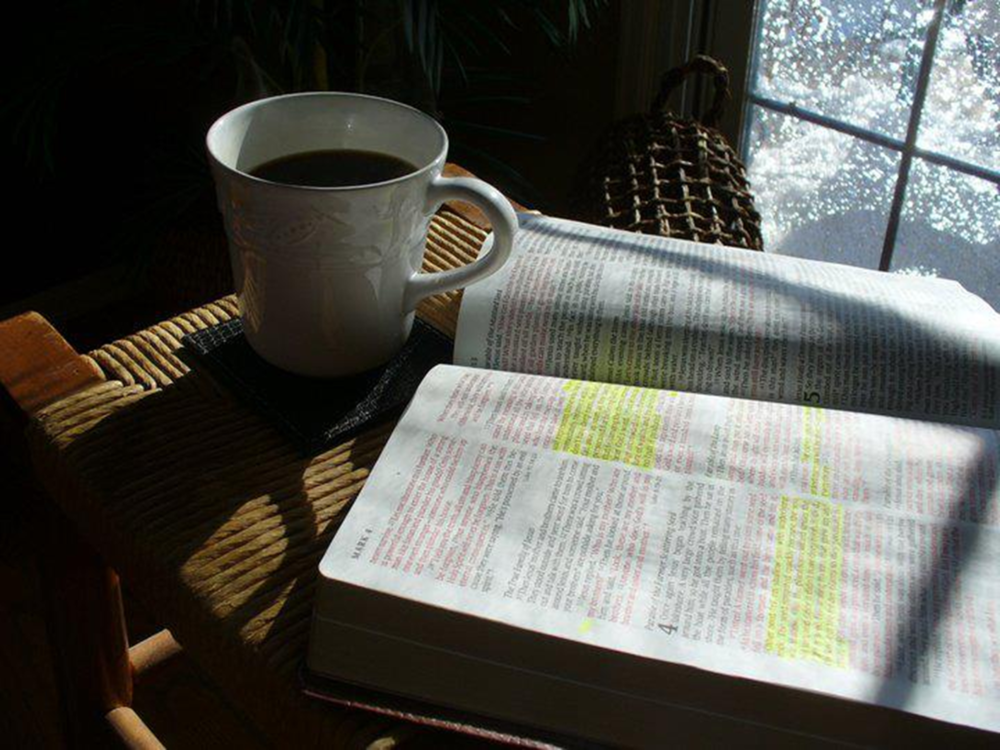
Finishing up Acts 11 this morning as part of my reading plan. As is my habit, as I’m reading I’m coloring. It’s my way of slowing down and observing what’s in the text–underlining or shading parts of the text with different colored pencils. So with red I underline references to the proclaiming and the power of the gospel as I read of the scattered disciples “speaking the word”, and “preaching the Lord Jesus”, and of “a great number who believed and turned to the Lord.”

But I also noticed that between the preaching and the believing there’s an unseen dynamic at play.

But there were some of them, men of Cyprus and Cyrene, who on coming to Antioch spoke to the Hellenists also, preaching the Lord Jesus. And the hand of the Lord was with them, and a great number who believed turned to the Lord.

(Acts 11:20-21 ESV)

Between preaching the Lord and turning to the Lord there is “the hand of the Lord.”

And almost without thinking I reach for my “sky blue” pencil crayon (that’s Canadian for colored pencil) and underline “the hand of the Lord.” My observation? This is the active agency of the Holy Spirit at work. Though His name is not mentioned explicitly, you know the power to save is through Him.

And isn’t that often how the Holy Spirit operates? Incognito? Not drawing a lot of attention to Himself but to the member of the Trinity He has purposed to glorify, the Son? Not seeking to make a name for Himself but delighting to accomplish the Father’s will as He illuminates the Father’s word to men and women? Not concerned about making Himself known as the member of the Trinity who makes dead things alive, instead only concerned with providing the power?

Faithful preaching results in authentic conversion only as the Spirit makes alive souls to the truth of the gospel.

. . . He saved us, not because of works done by us in righteousness, but according to His own mercy, by the washing of regeneration and renewal of the Holy Spirit, whom He poured out on us richly through Jesus Christ our Savior

(Titus 3:5-6 ESV)

If Jesus is the arm of God (Isa. 53:1), then the Spirit is the hand of the Lord. Through Him the fingertips of God touch this earth.

Through Him the Father raised the Son from the dead. By Him souls are not only saved, but men and women are transformed as the Spirit works to conform their nature to that of Jesus’ nature.

Almost imperceptibly, He reveals the deep things of God as He illuminates the Word of God. What’s more, He will bring to mind the truths of God when we need to draw on them.

The hand of the Lord is upon us as the Spirit dwells within us. The power of God is at work in us because the Spirit has sealed us.

Though He seeks no recognition, thanks be to God for the gift of the Holy Spirit.

By our Triune God’s grace. For our Triune God’s glory.

Posted in Acts, Uncategorized | Tagged , | Leave a comment

Who’s Talkin’ To Who?

I don’t to it every morning, but often, after reading the passages in my reading plan, and while I’m noodling on what I’ve read, I’ll go back through my online journal and see what thoughts have come to mind in past years. Sometimes it’s because I’m feeling full and I’m curious as to how that fullness overflowed in the past. Sometimes it’s because I’m feeling somewhat dry and I often find a thought from the past has a way of ministering to my soul. This morning, feeling a bit dry and so I’m “thumbing” through the archives. And this thought from back in 2008 has been good for me to chew on.

=====

So, kind of an interesting one-two punch from the Word this morning between Matthew 7 and Acts 10. A one-two punch is where the boxer sets up his opponent with the first punch and then delivers the second to the exposed area. The “set up” was a familiar reading in Matthew.

“Ask, and it will be given to you; seek, and you will find; knock, and it will be opened to you. For everyone who asks receives, and the one who seeks finds, and to the one who knocks it will be opened.” ~ Jesus

(Matthew 7:7-8 ESV)

Pray. Ask, seek, knock. And you’ll receive, find, and have entrance. Just ask Him!

So, the set up is a reminder of how important prayer needs to be in my life and that I need to take time to talk to God.

Then to Acts 10. And what do I read of in the first few verses? Prayer.

Cornelius, a Centurion . . . aka a Roman . . . aka a Gentile, was a man who “prayed continually to God” (Acts 10:2). And then I read of Peter going up on a housetop to pray (Acts 10:9). And at first, my reaction is, “How cool. Acts 10 reinforces Matthew 7. Yeah, prayer is important.” But then I see something that makes it even cooler. Who’s talkin’ to who?

Cornelius is praying like he always does — asking, seeking, knocking — and then BAM!!! An angel appears to him in a vision. Peter thinks he’s about done talking with God — asking, seeking, knocking — ’cause he’s getting hungry and then BAM!!! He falls into a trance and heaven is opened up to him and he has a thrice repeated argument with the Lord of heaven.

Now, I don’t think Cornelius was on his knees saying, “May I talk with an angel, please.” And, I’m pretty sure Peter wasn’t knocking on the door to heaven asking for something that would turn his world upside down, as in”Gentiles are people too,” or, “God desires to save them just as He desires to save the children of Israel–so don’t call anything unclean.” So, again, I ask, who’s talkin’ to who?

And it makes me think that I should be prepared for the possibility of a similar dynamic to occur in the context of my prayer life. That is, don’t be surprised if, when you’re talking with God about your world, that He ends up talking to you about His.

Now, I’m not saying that we should expect visions frequently. I’m guessin’ those are pretty rare. And I’m not saying that every time we close our eyes we’ll “hear His voice.” But, I guess I am saying we at least should be listening for it. I think we should expect that sometimes we are going to come to God with our prayer list and He’s going to change the subject and talk to us about His plans for our lives or the lives of those around us. Kind of adds an exciting dimension to prayer, doesn’t it?

Father, I desire to know more the fullness of communion that prayer can bring. Help me in finding the time and focus to go to my “roof top” and ask and seek and knock in prayer. And, Lord, as I’m talking to You, help me to be attentive to Your voice and recognize when You’re really talking to me.

For my continued growth in Christ . . . and for Your glory . . . Amen.

Posted in Acts, Matthew, Uncategorized | Tagged , | Leave a comment