
His Righteous Triumphs

Deborah. A wife, a prophetess, a judge of Israel (Jud. 4:4). Willing to be a “right hand man” for a fearful general called by a faithful God (4:6-9). And, a singer songwriter. This morning I’m hovering over her song in Judges 5.

It’s a song of victory. It’s a song of a mighty God who graciously rescues a rebellious people (again) for His redemptive purposes. A tale of triumph over a terrible oppressor. An ode to a tent-dwelling, stay-at-home mom who crushed the head of a powerful military enemy. But the thing that grabs me in particular as I chew on this lyrical collaboration between a judge of Israel and a general of Israel, is the integral dynamic between God’s mighty purposes and God’s not so mighty people.

“That the leaders took the lead in Israel, that the people offered themselves willingly, bless the LORD! . . .

My heart goes out to the commanders of Israel who offered themselves willingly among the people. Bless the LORD.

“Tell of it, you who ride on white donkeys, you who sit on rich carpets and you who walk by the way. To the sound of musicians at the watering places, there they repeat the righteous triumphs of the LORD, the righteous triumphs of His villagers in Israel.”

(Judges 5:2, 9. 10-11 ESV)

It was God who heard the cries of a people cruelly oppressed for twenty years (4:3) and determined to deliver them. But His power would be shown through His people. Rather than send a host of heaven, He would send those who repeatedly fell to the flesh.

Oh, but when their leaders lead, when the people offer themselves willingly, then the righteous triumphs of the high and holy LORD of heaven become the righteous triumphs of a lowly and less then always reliable people. Bless the LORD!

Yeah, I’d like to think I’m Deborah. But I know I am far more like Barak. Yet, when all was said and done, they both offered themselves willingly (though Barak not unconditionally). These leaders led. Their commanders followed. And an oppressed people gained victory over their mighty oppressors. A victory through the woven cord (Eccl. 4:12) of a Triune God and His called out people. A righteous triumph.

The triumphs of God are the triumphs of His people. The triumphs of His people, triumphs of God. Talk about an intimate yoking. Talk about linking two things together which only in the sovereign purposes of a loving God make sense to tie together. Oh, the wonder of the depths to which God is determined to work for His people even as He binds Himself to them and works through His people.

And not just an Old Testament thing.

“Abide in Me, and I in you. As the branch cannot bear fruit by itself, unless it abides in the vine, neither can you, unless you abide in Me. I am the vine; you are the branches. Whoever abides in Me and I in him, he it is that bears much fruit, for apart from Me you can do nothing. . . . By this My Father is glorified, that you bear much fruit and so prove to be My disciples.” ~ Jesus

(John 15:4-5, 8 ESV)

I have been crucified with Christ. It is no longer I who live, but Christ who lives in me. And the life I now live in the flesh I live by faith in the Son of God, who loved me and gave Himself for me.

(Galatians 2:20 ESV)

A God intricately connected with His people. A people willingly rising to follow their God. Such are the dynamics of His righteous triumphs.

Only through His abundant grace. Only for His everlasting glory.
Posted in Judges | Tagged , , , , | Leave a comment

A Drip of Disobedience

It’s the first drip in what quickly becomes a gushing reality. The first hint that the worst is yet to come. The beginning of the setup as to why Israel would come to need judges to deliver them. And, as I chew on it this morning, it’s a pretty curious statement.

And the LORD was with Judah, and he took possession of the hill country, but he could not drive out the inhabitants of the plain because they had chariots of iron.

(Judges 1:19 ESV)

The LORD was with Judah. But Judah couldn’t drive out the inhabitants because they had chariots of iron. Weird!

For 18 verses Judah has been kicking keister and taking names. Literally. After Joshua’s death, operation “Take the Land” continues as the book of Judges opens, and Judah, along with Simeon, are the first out of the gate. They fight, they defeat, and the names of kings, places, and people are listed. The LORD God who said, “I have given the land into his hand” is giving the land into his hand (1:2, 4). But apparently, there’s a problem when it comes to iron chariots. And so they didn’t drive out the inhabitants of the plain. Drip.

Then it’s Benjamin which, for some reason, doesn’t drive out the Jebusites (v.21). Drip, drip. Then Manasseh “did not drive out the inhabitants” (1:27), and Ephraim didn’t drive out the Canaanites (1:29). Then Zebulun, Asher, and Naphtali, without explanation, “did not drive out the inhabitants.” It’s free flowing now — “Take the Land” has become operation “Share the Land”. And, while the other tribes were at least able to subject the un-evicted Canaanites to forced labor, the tribe of Dan is actually unable to move in to their allotted land in the plain and are “pressed back” into the hill country by the Amorites (1:34). Gush!

And the people who God said to remove, remain. And not just the people, but their altars as well. And the angel of the LORD calls it for what it is . . . and for what it will become.

“You have not obeyed My voice. What is this you have done? So now I say, I will not drive them out before you, but they shall become thorns in your sides, and their gods shall be a snare to you.”

(Judges 2:2b-3 ESV)

And it all started because of chariots of iron. Hmm . . .

At first reading, it makes you wonder, are iron chariots the God of Creation’s kryptonite? Is He the omnipotent God except when it comes to the 26th element on the periodic table, Fe? Nope, that’s not it.

Instead, it seems that there was something about iron chariots that caused Judah to waver. Maybe the sheer display of force struck fear in them. Maybe it was the unknown, how do you fight chariots of iron, that caused them to say, “Pass.” Or, maybe they were just getting tired, relying more on their own power than on the LORD who was with them, and felt like they needed to tap out. Or perhaps, they just became complacent and lazy, and settled for “good enough”, iron chariot’s being just an excuse to call it a day.

I don’t know. Whatever it was — faltering faith, worn-out weariness, or a smug sense of security — Judah failed to obey the LORD and cleanse the land of what God had warned them would be thorns and snares. And this drip of disobedience quickly became a flood of failure.

There’s gotta be a warning here for those with ears to hear. Our God’s hand is not too short to save. Instead, it’s our sin which can hamstring our salvation (Isa. 59:1-2). Our complacency which can compromise God’s power. Our inability, or unwillingness, to trust the LORD with all our heart that can lead us to settle for thorns in our sides and snares around our feet.

Yup, the setup is complete for the book of Judges. Let the rollercoaster ride begin.

But even as I anticipate working my way through this book, I know that when God’s people cry out to God, God in His mercy and grace delivers His people, again and again. He sets them back on their feet. He patiently calls them to resume the mission. Faithfully, He promises again to be with them.

The drip of disobedience met with rivers of grace.

All for the glory of God.

Posted in Judges | Tagged , , , | Leave a comment

Pay Attention to What You Hear

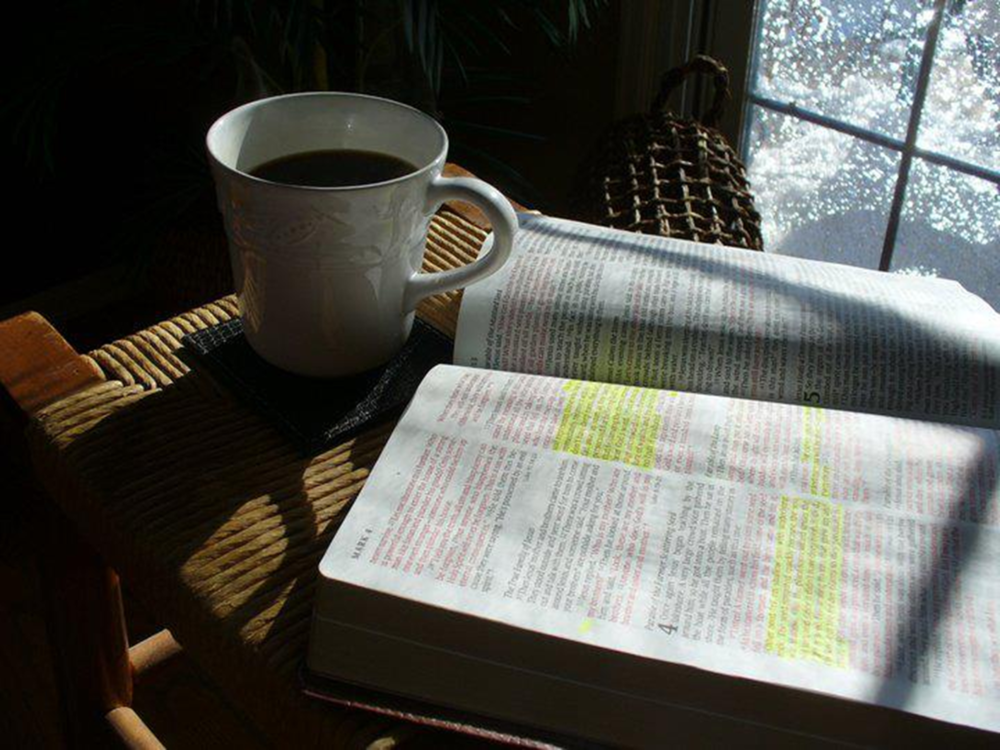
As I hover over some verses in Mark, two common sayings come to mind. One from my days in the business world, the other from the world at large. Back in the days when I drove to an office building every day, we’d often kid, “Yeah, the reward for taking on a lot of work is more work.” Conversely, it’s pretty common to hear folks from all walks of life concede that there seems also to be a life principle of “Use it or lose it.” Reminded this morning that there’s a biblical basis for both.

And [Jesus] said to them, “Pay attention to what you hear: with the measure you use, it will be measured to you, and still more will be added to you. For to the one who has, more will be given, and from the one who has not, even what he has will be taken away.”

(Mark 4:24-25 ESV)

Pay attention to what you hear. That’s the “command to obey” which caught my eye this morning and had me grab for my purple colored-pencil and underline it.

Context? Jesus has just explained the parable of the sower and seed to “those around Him with the twelve” (4:10). He’s providing insider intel for those who have left the crowd and are wanting to follow at “the next level.” Those wanting more than just the signs and wonders but who hunger and thirst for the secrets of the kingdom. And the parable is about “the word.” The parable is about supernatural dynamics involving the soil of the heart, the truth of God’s word, and a fruitful harvest made possible by the two coming together.

So, says Jesus, because the word of God is the light of God — because a lamp is meant to shed light on darkness, to make manifest what was hidden, to bring to light what was once in secret (4:21-22) — pay attention to what you hear.

“Consider carefully” (NIV). “Take heed” (NKJV). “Listen carefully” (MSG). Or, as one literal translation mixes metaphors, “Keep ever a watchful eye on what you are hearing” (Wuest New Testament).

But more than just a command to obey for the sake of being obedient, it’s a command with a promise. And a warning. A command that reveals the workings of the kingdom’s economy. A dynamic which explains, at least in part, why some flourish while others seem to be stuck in perpetual famine. A dynamic which reminded me of those two common sayings. The more you do with the truth you’ve been given, the more truth you will be given. But it’s a use it or lose it proposition.

Truth used is truth multiplied. Truth ignored is truth lost.

To the degree we pursue truth, truth will be found. With the measure we use, it will be measured. The more we take in and then invest for the kingdom, the more which will be given by the kingdom. It ties with the law of the harvest, sow a lot and you’re gonna reap a lot. Not because you’re a great sower, not because it’s owed for your effort, but because that’s the way the kingdom works. Those who hunger and thirst after righteousness will be filled (Matt. 5:6). And that filling serves to generate more hungering and thirsting. Which, in turn, will be filled as well. And, in turn again, creates a desire for more.

But carelessly dabble in truth, and eventually there’ll be a drought of truth. Play half-hearted games with God’s word, and eventually you’ll lose all interest in God’s word.

So, says Jesus, Pay attention to what you hear.

Only by God’s grace. Always for God’s glory.

Posted in Mark | Tagged , , | Leave a comment

He Wholly Followed the LORD

Okay, not gonna lie, the CSB took a bit of a hit for me this morning.

While I’m pretty quick to pull the trigger on some things, other things, like switching which translation of the bible I use, takes a bit longer. It’s been over 10 years since I made the call to start reading the English Standard Version (ESV) rather than the New King James Version (NKJV) which I had been reading for years before that. Over the past couple of years, I’ve been toying with whether it wouldn’t be beneficial to change things up a bit and starting reading the Christian Standard Bible (CSB) translation. Part of considering that switch is to reference the CSB in my bible app during my morning readings. This morning, for me at least, the CSB fell a bit short when it came to bearing witness of Caleb’s character.

Bearing witness. That’s the thought that came to mind as I read Joshua 14 this morning. Particularly the biblical principle of a matter being established by two or three witnesses (Mt. 18:16, 2Cor. 13:1, 1Tim. 5:19). And in Joshua 14, there are clearly three witnesses bearing testimony concerning Caleb.

“But my brothers who went up with me made the heart of the people melt; yet I wholly followed the LORD my God.”

~ Caleb’s testimony on his own behalf (Joshua 14:8 ESV)

“And Moses swore on that day, saying, ‘Surely the land on which your foot has trodden shall be an inheritance for you and your children forever, because you have wholly followed the LORD my God.‘”

~ Moses’ testimony (Joshua 14:9 ESV)

“Therefore Hebron became the inheritance of Caleb the son of Jephunneh the Kenizzite to this day, because he wholly followed the LORD, the God of Israel.

~ Joshua’s testimony (Joshua 14:14 ESV)

On the evidence of three witnesses, I’m thinking I’m on pretty solid ground to take away that Caleb wholly followed the LORD. And here’s where the CSB comes up short for me, it translates the original as Caleb “remained loyal” to the LORD.

Now I get the connection and how both translations convey the same idea. But you gotta admit, there is a weight to the ESV that I don’t get from the CSB. While the CSB may be accurate, the ESV is inspiring.

The single word in the original has the idea of being filled, or complete. Some translations use the word fully. How did Caleb follow the LORD? Fully. All in. Wholly. Remained loyal feels like he stood His ground. Wholly followed conveys more the sense he was about taking ground.

Not a big deal. I really do think that next year I may start using the CSB for my morning readings. But this morning, my soul is stirred as think I about someone wholly following the LORD. Aspiring to be like that someone. But realizing that while Caleb might be great example for me, He is an even better foreshadow of the One who came to rescue me. Jesus wholly followed His Father’s will.

My Savior was all in. Fully committed. Didn’t waver from taking ground the enemy thought he had secured.

Praise God for a Redeemer who wholly followed the LORD!

The fullness of God’s grace. Completely in for God’s glory.

Posted in Joshua | Tagged , , | Leave a comment

What I Don’t Know Can Hurt Me

There’s an old proverb that says something like, “What you don’t know can’t hurt you.” What it’s getting at is that, if you are unaware of a problem, you can’t get bent out of shape worrying about it. Something along the lines of another saying that’s been around for a while, “ignorance is bliss.”

You don’t have to noodle on the proverb very long before you know it’s just not true. From disease to two-faced relationships, like walking in a minefield unaware, we can probably come up pretty quickly with a number of scenarios where not knowing about something is eventually going to cause great harm. Another example is something I came across in one of my readings this morning.

In Paul’s first letter to the church at Corinth he’s dealing with divisions in the church. Divisions centered around a growing celebrity culture within the church. Not so much identity politics as identity superstars. Chloe’s “people” are ratting out other people who are saying, “I follow Paul,” or “I follow Apollos,” or “I follow Cephas.” And the really “spiritual” people have their own tribe as they smugly declare, “Well, I just follow Christ” (1Cor. 1:11-12). To which Paul responds emphatically to all, “Is Christ divided?”

After addressing the danger of divisions in the church in chapter three, in chapter four he continues by saying, in effect, don’t put us preachers on a platform, instead consider us as servants of Christ. I’m not a superstar to be followed, I’m just a steward called to be faithful (4:1-2). And in that context, Paul writes:

But with me it is a very small thing that I should be judged by you or by any human court. In fact, I do not even judge myself. For I am not aware of anything against myself, but I am not thereby acquitted. It is the Lord who judges me.

(1Corinthians 4:3-4 ESV)

For Paul, what his “fans” (or his critics) thought about him really counted for very little in the grand scheme of things. But what hits me is that he says that not even his own self-evaluation was a basis for confidence in his performance. That even if “I am not conscious of anything against myself, I am not justified” (CSB). Rather, it’s what the Lord knows that counts. It’s what the One who searches hearts finds in the heart that is the final determiner. Stuff that only the Lord knows. So, putting it another way, what I don’t know can still hurt me. Hmm . . .

I have heard so much about conscience over the past couple of years as the ultimate and final arbiter for doing, or not doing something. And to be sure, the Scriptures warn us about cauterizing our conscience (1Tim. 1:18-19, 4:1-2), and encourages us to act out of a clear conscience (1Tim. 1:5). But if I’m picking up what Paul is laying down, it’s that our consciences aren’t infallible, they aren’t the sole test of our faithfulness. Ultimately, it is the Lord who judges me.

Okay, what do you do with that? Here’s a case where something you don’t know can certainly hurt you. But rather than experiencing fear, uncertainty and paranoia because of the realization that we can’t rely only on what we think we know about our actions and motives, it should bring about a degree of humility and dependency.

It’s what kept Paul off the pedestal people were trying to put him on. It’s what kept him from an inappropriate degree of self-confidence and self-reliance. Just because Paul wasn’t aware of anything that might disqualify him “from being a good guide”, it didn’t mean much (MSG). Instead, Paul says, count me but a servant of Christ. Consider me just a steward of the mysteries of God (4:1).

A servant. A steward. If that’s what we know, if that’s how we regard ourselves, then, as much as we can know, it won’t hurt us. Instead, it will keep us abiding in the vine. It will keep leading us to the cross. And it will eventually usher us home where we hope to hear, “Well done good and faithful servant.”

Only by His grace. Only for His glory.

Posted in 1Corinthians | Tagged , , , , | Leave a comment

The Dynamics of Division

Divisions in the church. That’s the non-inspired heading in my bible for 1Corinthians 3. That’s the overall topic Paul’s addressing. That’s the context.

And as I sit back and look at my now colored page, it’s all the red-shading that catches my eye — observations about the people of God.

In chapter 3 the following terms are applied to people in the church:

  • brothers
  • not spiritual people
  • people of the flesh
  • infants in Christ
  • God’s field
  • God’s building
  • God’s temple

Hmm . . . pretty diverse set of terms. A split between who they are in Christ and how they’re behaving in the flesh. The family of God but acting like baby brothers and sisters. A spiritual field, but sowing seeds of the flesh. A spiritual temple of God under construction yet acting anything but spiritual and so tearing down rather than building up. Seems that’s the dynamics of division.

Paul’s going to address a lot of issues in this letter to the church at Corinth. But I think it’s significant that the first one he tackles out of the gate is division. He addresses the “jealousy and strife” among them as it’s the evidence that they are “not of the flesh and behaving only in a human way” (3:3). I’m guessing that behaving only in a human way is probably at the heart of all the stuff Paul’s going to take on later in the letter.

Behaving in a human way. Other translations render it: “living like ordinary people” (CSB); “walking, [or living, or acting] like mere men” (NASB, NIV, NKJV). NLT says “living like people of the world.” Division in the church was a sign of being overly-influenced by the prevailing culture. It stunted their growth as a heavenly temple because it kept bringing in materials valued from an earthly perspective. The world outside influencing the ways of the church inside stunting the growth of the place where God desired to reside. That’s the dynamics of division.

And so, Paul’s exhortation to these baby brothers and sisters:

According to the grace of God given to me, like a skilled master builder I laid a foundation, and someone else is building upon it. Let each one take care how he builds upon it. For no one can lay a foundation other than that which is laid, which is Jesus Christ.

(1Corinthians 3:10-11 ESV)

How quickly I apply this verse to me, myself, and I. Thinking exclusively along the lines of, “What am I doing to build on the foundation of my salvation?” But given the context, shouldn’t I be thinking also along the lines of Matthew 16:18, recognizing I’ve also been saved to build on the bedrock of Christ the Son of the living God as He builds His church? Could be.

Rather than thinking only about me standing before the Bema Seat (1Cor. 3:13-15, 2Cor. 5:10) and giving an account for how I participated in my own spiritual growth, wouldn’t it be reasonable to also anticipate a question along the lines of “So, how did you build up your church, My field, My building, My temple? Or did you keep undermining the structure with contention and wrangling?”

Seems to me that at least part of what Paul’s saying here is that spiritual people, mature believers, are recognized by how they put their shoulder to the task of building God’s spiritual temple. And infants in Christ, people of the flesh walking like the rest of the world, get caught up in the dynamics of division and compromise what the Lord wants to build on the foundation of His Son.

Something to chew on, I think.

By His grace. For His glory.

Posted in 1Corinthians | Tagged , , , , | Leave a comment

God’s PQ (A 2011 Rerun)

Unobservable . . . imperceptible . . . imponderable . . . such are the things God has prepared for those who love Him. But doesn’t that present a bit of a problem? If these things are beyond what any eyes have seen . . . so hidden that no ear has heard of them . . . so out there that our minds can’t even imagine them . . . then it’s good stuff beyond our reach . . . beyond our even knowing that there’s something to reach for. Stuff beyond any natural connection. Cue the supernatural . . . cue God’s PQ . . .

” . . . these things God has revealed to us through the Spirit. For the Spirit searches everything, even the depths of God.”

(1Corinthians 2:10 ESV)

A bit blown away this morning as I consider Paul’s assertion that, as believers, we have the mind of Christ (2:16). That we have received “the Spirit who is from God, that we might understand the things freely given us by God” (2:12). That we might comprehend things which are beyond the natural man’s comprehension. Not because we have a particularly high IQ . . . but because God has an out of this world PQ . . . because of God’s Power Quotient . . . the blessed Holy Spirit.

When Paul hit Corinth he didn’t come trying to convince them of the testimony of God with “lofty speech or wisdom” but determined, instead, to know nothing among them “except Jesus Christ and him crucified” (2:2). He didn’t approach the pagan culture with “plausible words of wisdom” but instead preached the foolishness of the cross that, any difference it made, would be a demonstration of the Spirit and of power . . . “that your faith might not rest in the wisdom of men but in the power of God” (2:4-5). And once God’s PQ was manifest in this way . . . hold on to your hats . . . the flood gates of the unimaginable just open up.

“Yet among the mature we do impart wisdom, although it is not a wisdom of this age . . . But we impart a secret and hidden wisdom of God, which God decreed before the ages for our glory.”

(1Corinthians 2:6-7 ESV)

Secret things . . . hidden things . . . things ordained of God before even the creation of the world. High things . . . lofty things . . . heavenly, spiritual things . . . things beyond the grasp of natural man. And these things are imparted to us. The flood gates of the unobservable and imperceptible has been open to those who, by faith, have “seen” Christ crucified . . . risen on the third day . . . ascended into glory . . . interceding at the right hand of the Father . . . making ready a place for us . . . preparing for the day of His return. A little bit of faith opens up a lot of “secret and hidden wisdom” through the Spirit of God . . . through God’s PQ.

Oh, what danger when I start to think that because of my smarts and my diligence I’m the one who’s figuring it all out. Nope . . . instead, I’m just the one who’s receiving what He’s graciously giving. It’s not about my skill in interpretation . . . but all about His grace in illumination and revelation. Not about my intelligence quotient . . . but about His power quotient, manifest through the Spirit of God, the One who will lead us into all truth (John 16:13) . . . even truth beyond our imagination.

Father, by Your grace, through Your Spirit, continue to open my eyes to the unobservable . . . and give me ears to hear the imperceptible . . . and a mind to ponder the imponderable. That I might know You . . . and the power of the Spirit in me.

By Your grace. For Your glory. Amen.

Posted in 1Corinthians | Tagged , , | Leave a comment

A Song for Old People

Hovering over Psalm 71. There’s a song for old people in the bible, for those “in the time of old age” (v.9) and sporting a few “gray hairs” (v. 18). Who knew?

Apparently, it hit my radar a couple of years ago, as well — when being “old” was to be “at risk” for some newly discovered, highly contagious, fast spreading disease.

Somehow you think that the senior years should be serene and simple years — not so much. Not for us, not for the ancient songwriter. But God remains a refuge. The One who has been my trust from youth is worthy of my hope in my not-so-youth. Still worthy of my praise continually. Still faithful. For the One who has “made me see many troubles and calamities will revive me again” (v.20). Even so, Lord Jesus, revive me again.

Here are my thoughts from March 2020 . . .


Good Sunday with the church yesterday. Not, at the church, but with the church.

Our “sheltered in place” body met together via the wonders of technology, some “connecting” afterwards with texts and emails of mutual encouragement. After “going off the air”, my co-production buddy and I sat with the Lord around His table and remembered His past work on our behalf on the cross and, rejoiced in His current work on our behalf making intercession at the right hand of the Father. Then we transitioned from our makeshift “broadcast studio” to his office, pulled out our guitars and worshiped. So sweet! And after an afternoon of more sheltering in place (which I do most Sunday afternoons in a semi-conscious fashion, so not too different), I got to hang out with my small group via video conferencing last night. Just seeing those saints is a balm for the soul.

Like I said. A good Sunday with the church yesterday. Last night’s sleep was the best sleep I’ve had all week.

But, here we are, another week of uncertainty in front of us.

And, as I’m reading in Psalm 71 this morning, a reminder of something that irks me about the current situation we’re enduring. The constant reminder that I am in the “at risk” group. The reminder that I’m not the young and the invincible any longer. That I’m way past the “spring chicken” season of life. (Also a reminder that my ego still has some sanctifying to undergo.)

As I hover over the songwriter’s song this morning, guessing it’s David, he’s older and still having to deal with troubles in his life. And still having to make the conscious decision, every day, to take refuge in the LORD, to “continually come” to the One who is his rock and his fortress (71:1, 3).

Seems his “golden years” aren’t so golden. You know what I mean. In our culture in particular, we want to believe that our latter years should be our more leisurely years. That it should be a season of more ease than exertion, of more comforts than concerns, of more carefree wandering then constant worrying. Isn’t that what the golden years should be about? Not necessarily, it would seem.

And here’s the perspective offered by the songwriter that’s got me thinking this morning. Here’s what I’m chewing on . . .

O God, from my youth You have taught me, and I still proclaim Your wondrous deeds. So even to old age and gray hairs, O God, do not forsake me, until I proclaim Your might to another generation, Your power to all those to come. Your righteousness, O God, reaches the high heavens. You who have done great things, O God, who is like You?

(Psalm 71:17-19 ESV)

The stuff the songwriter had known from his youth, would be the stuff that would sustain him in his golden years, even when, at times, the gold seemed a bit tarnished.

While things around us might change ever so drastically, and ever so quickly, our God never changes. He is still the God of the wondrous deeds of the past. His power is still all-powerful. His righteousness, still perfectly righteous. His faithfulness, always faithful.

And I’m inspired by the psalmist’s motivation for running to his Rock, for wanting to keep on keepin’ on, for wanting to finish well — so that he could proclaim the might of His God to another generation. To not just shelter in place to self-preserve, but, even in how he sheltered in place, to model what it is to trust in his Rock and his Refuge. To live out what it is to really “walk by faith and not by sight” (2Cor. 5:7).

For You, O Lord, are my hope, my trust, O LORD, from my youth.

(Psalm 71:5 ESV)

Another week ahead of us, if the Lord be not come, to declare His goodness to another generation. To testify of His power to all who might hear. Even as we shelter in the shadow of His wings (Ps. 57:1).

I might be in the “at risk” stage of life, but I also want to be in the “at peace” rhythm of life.

Sheltered in place. Sheltered in peace.

By His grace. For His glory.

Posted in Psalms | Tagged , , | Leave a comment

Offering and Obedience

Hovering over a couple of verses in the last part of Romans 15 this morning. Coming to terms with some terms of salvation.

But on some points I have written to you very boldly by way of reminder, because of the grace given me by God to be a minister of Christ Jesus to the Gentiles in the priestly service of the gospel of God, so that the offering of the Gentiles may be acceptable, sanctified by the Holy Spirit. In Christ Jesus, then, I have reason to be proud of my work for God. For I will not venture to speak of anything except what Christ has accomplished through me to bring the Gentiles to obedience —  by word and deed . . .

(Romans 15:15-18 ESV)

Offering and obedience. Hmmm . . . those aren’t terms we often lead with when we share the good news. Believe the gospel and be an offering to God. Receive Jesus and be obedient in word and deed. Doesn’t have the same ring to it as God loves you and has a wonderful plan for your life.

I’m not saying God doesn’t love the sinner and that He doesn’t have a plan which is wonderful, for all that God does is full of wonder. I’m just noodling on the fact that I think we’ve tended to shy away from language related to sacrifice and submission over the past generation and thus perhaps have weakened the gospel by trying to remove some of the offense of the gospel. Naturally speaking, I’m more likely to sign up for a wonderful life than for being an offering to God and obedient to God.

And I wonder if we haven’t sought to be “seeker sensitive” and “seeker friendly” — and downplay taking up a cross, dying to self, and becoming a bond servant for Christ — because, before that, we may have hammered too often on sacrifice and submission as the responsibility of believing rather than the natural, supernatural response of believing. That somehow, we communicated that now that you’re saved you gotta buckle down and be sanctified.

But the reading of today’s text indicates that being set apart as an offering, that being sanctified, happens by the Holy Spirit. That to be brought to obedience is something that Christ has accomplished. That far from being the burden to bear when we come to faith in Christ, it is the fruit that is born because of faith in Christ. Sacrifice and submission being less something we need to make happen and more something we are to let happen as the Son of God lives through us by the Spirit of God in us.

Let happen, but not as in do nothing and passively wait for holiness to take hold. Instead to see myself as an offering to God, recognizing up front that I have been purchased with a price and I’m no longer my own. And to know that, having already obeyed the gospel by receiving and believing the good news by the grace of God, I’ve been saved to continue to obey by the grace of God. By faith, wanting to do in the Spirit what I could never do when controlled by the flesh. Pursuing the knowledge of Christ, abiding in the love of Christ, and living for the glory of Christ, because it’s how I’ll flourish in Christ. Offering and obedience viewed as part of the benefit of believing and less as a burden of believing.

Terms of salvation are important. Offering and obedience, by the Holy Spirit and through the Risen Son, are to be embraced. They are the fruit of salvation, the logical outcome of new creations being conformed to the likeness of Christ. Not something we must do to stay saved, but something we want to do because we have been saved.

Only by His grace. Only for His glory.

Posted in Romans | Tagged , | Leave a comment

An Obligation

For the past few months I have been listening to a podcast that’s walking through the book of Romans. And what I have appreciated as much as anything over these months is the manner in which the “why” of Romans continually is re-emphasized as we walk through the “whats” of Romans. I so often think of this letter as only a theological treatise, a master defense of the gospel and it’s implications in the lives of believers. True enough. It is. But Paul wrote to the Roman church because it was a divided church.

After the gospel had come to Rome, a church of Jew and Gentile believers had been established. But then, all Jews (Christ-followers or not) were expelled from Rome by the emperor. When they were allowed to return some five years later, the Jewish believers came back to a pretty Gentile feeling church. And it created some tension. Tension along ethnic lines, Jew and Gentile. Tension along religious lines, adherence to the “old ways” vs. freedom to walk in some new ways. Tension in terms of understanding what God was doing now vs. what He had promised to do in the past. And so, Paul writes a pretty comprehensive and theological letter, not only to educate but to reconciliate. Not only to provide a gospel catechesis, but more importantly to spell out how to live as a gospel community.

Can’t help but think that Romans is a timely book to be reading given the tension in the North American church today as a result of the many polarizing and dividing issues of the last couple of years. A reminder that the gospel is not for individuals only, but that its power is also manifest where those individuals come together to form a community which, apart from the gospel, would have no natural inclination to be a community.

That’s the filter that seasons what I’m chewing on in Romans 15 this morning.

We who are strong have an obligation to bear with the failings of the weak, and not to please ourselves. Let each of us please his neighbor for his good, to build him up. . . . May the God of endurance and encouragement grant you to live in such harmony with one another, in accord with Christ Jesus, that together you may with one voice glorify the God and Father of our Lord Jesus Christ. Therefore welcome one another as Christ has welcomed you, for the glory of God.

(Romans 15:1-2, 5-7 ESV)

An obligation. That’s we have when it comes to arguing about “opinions” (Rom. 14:1) or “disputable matters” (NIV). An obligation of the strong to bear with the weak. And let’s be honest, in any disputable matter each side thinks they are “the strong” and the other is “the weak”. So, each side shares in the obligation to bear with others (who we think are wrong) and not please ourselves (by proving we’re right).

Beyond the debate there is a decision, is pleasing my neighbor and building them up a greater prize than being right? Is harmony within my church community priority over conformity as to our church conduct? Does my voice have to be the right voice over others, or am I more concerned that with one voice we together glorify the God and Father of our Lord Jesus Christ?

This obligation is my obligation. For I’m the only one who knows my heart towards my brothers and sisters. I’m the only one who can check my rhetoric in my brain before it proceeds out of my mouth. Only I know whether I want to be right above all or righteous for the sake of all.

And the power to fulfill my obligation? The source of my righteousness? It’s the gospel, the grand subject of Romans. The power of God for all who believe, Jew and Gentile — revealed from faith and for faith (Rom. 1:16-17).

An obligation, only by God’s grace. An obligation, ultimately for God’s glory.

Posted in Romans | Tagged , , , , , | 1 Comment